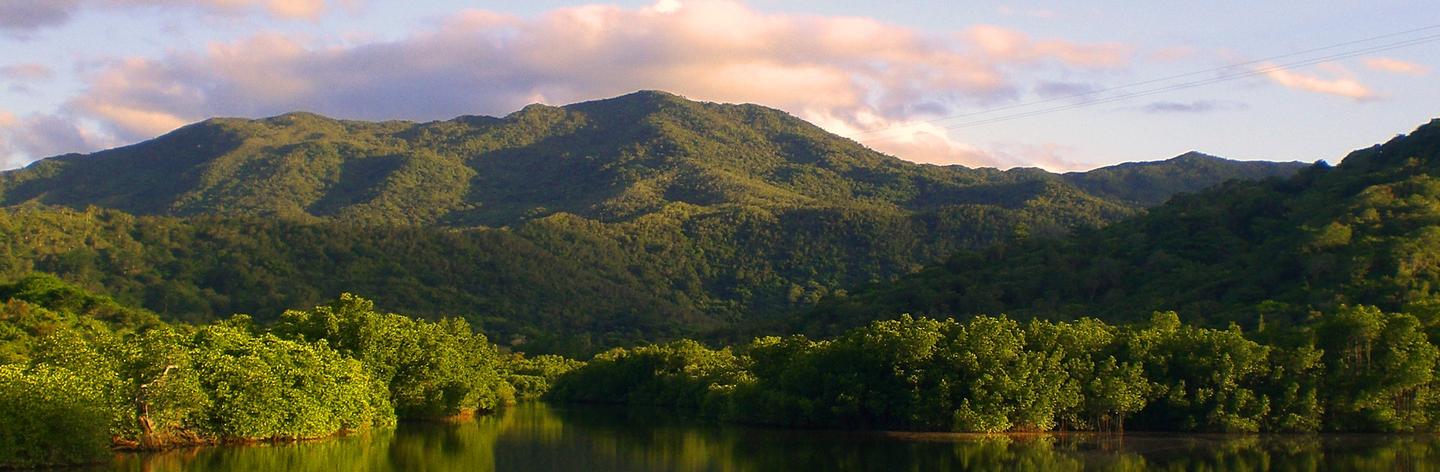
The rocky islets, coral atolls and volcanic islands of the Pacific region are reminiscent of a time when creatures first emerged from the sea. Today, the plants and animals there reflect the islands’ incredible natural history and present unparalleled opportunities for conservation.
The Pacific teems with life. Its thousands of islands support astonishingly high rates of endemism – on some islands, almost 100% of the plant and bird species are found nowhere else on earth. There are over 270 bird species in the Pacific, including the group of endangered Hawaiian honeycreepers, the recently rediscovered Long-Legged Warbler of Fiji and the endangered Tooth-billed Pigeon of Samoa. The French territory of New Caledonia alone supports over 2,400 endemic plant species. Across the region, however, more than 800 marine and terrestrial species have been identified as globally threatened.
The nature of the Pacific Islands region leaves it vulnerable to serious ecological threats, especially invasive species and climate change. Because many island species have evolved in isolation from their continental ancestors, the sudden introduction of rats or other invasive species can be devastating. Extinction rates in the Pacific are among the highest in the world.
At the same time, the effects of climate change are already being felt throughout the region. Rising sea levels and shifting species ranges are among the changes that are altering human lifestyles and ecosystems at a dramatic rate. CI is leading a science-driven approach to decrease greenhouse gas emissions and adapt our conservation approach to the changes already set in motion.
CI is leading numerous initiatives across the Pacific region, helping communities and governments define and establish marine protected areas and create sustainable development activities. These projects include the Coral Reef Initiative for the Pacific, funded by the French government, and the Regional Implementation Team for the Critical Ecosystem Partnership Fund, focusing on the Polynesia-Micronesia Hotspot. Our work on the ground is centered in Samoa, New Caledonia and Fiji where our offices are located.
The Phoenix Island Protected Area (PIPA) is a benchmark product of the partnership between the government of Kiribati, the New England Aquarium, and Conservation International. At 18.5 million hectares, it is the single largest marine protected area in the world and encompasses critical island, seamount, deep water and coral reef ecosystems.
In 2006, CI and The Nature Conservancy (TNC) agreed to support the launch of the Micronesia Challenge with a $6 million commitment to conservation across Micronesia. Five nations and territories pledged to protect a combined marine and terrestrial area of almost 200,000 hectares, twice the size of Portugal. With TNC, we were able to strengthen a network of partners to protect irreplaceable island and ocean life.
The Pacific Islands are a treasure for scientists who study biodiversity. CI is giving back by working to preserve the diverse land and seascapes that are spread across the Pacific Islands.