Editor’s note: In April 2025, after this story was published, the project described in this story won Environmental Finance’s 2025 award for Sustainability-Linked Loan of the Year, in recognition of the project’s innovative financing model and its environmental outcomes. Conservation International was one of three implementing organizations honored. More details about the award can be found here.
Read this story in Portuguese .
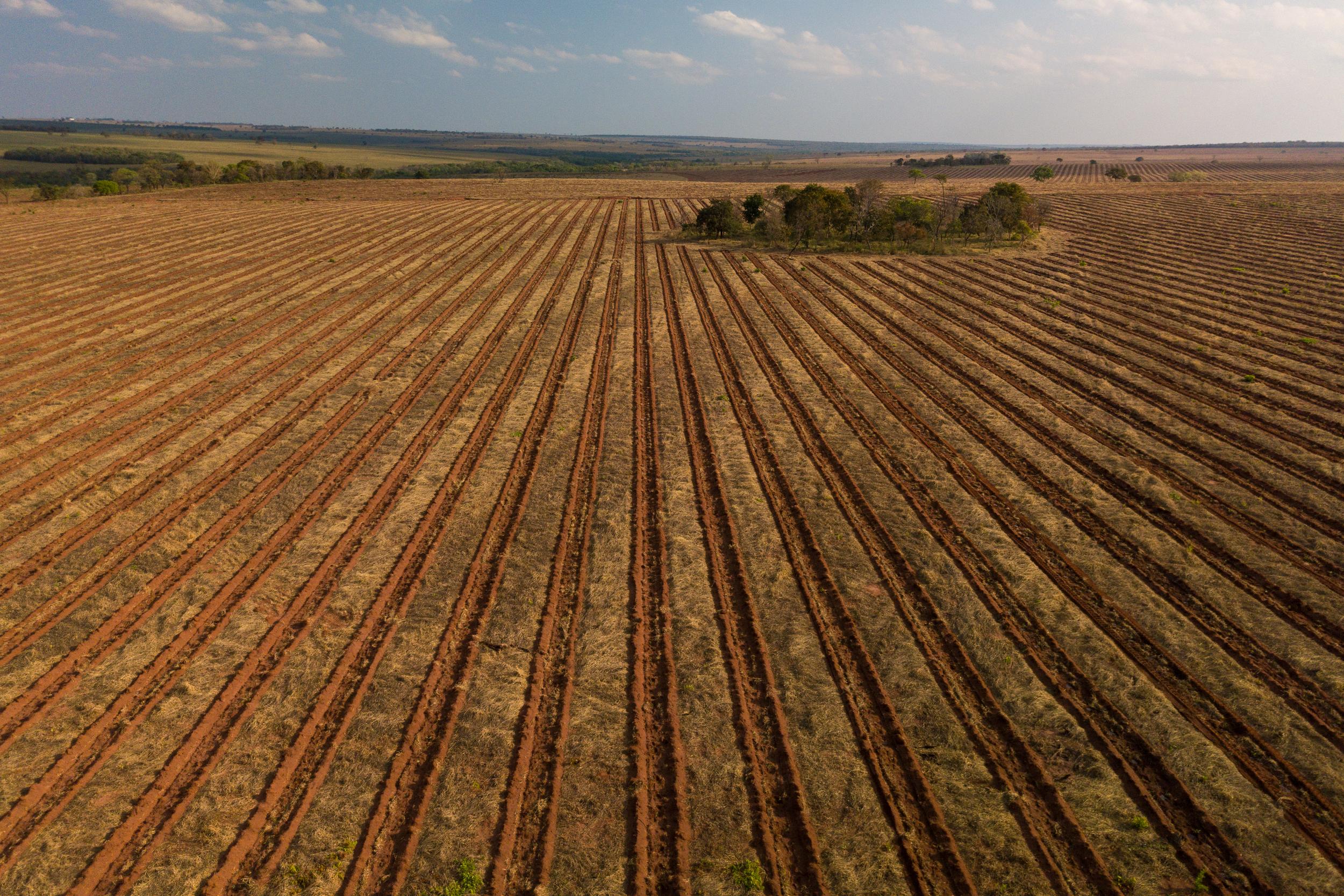
MATO GROSSO DO SUL, Brazil — On a blistering day in late August, Will Turner gazed across a dusty road, red as Mars, into the fringe of a dense forest — its canopy alive with the hum of insects and chattering birds. This forest in southern Brazil is an oasis — a remnant of a nearly forgotten ecosystem in a region now dominated by degraded cattle pastures.
Behind him, on the opposite side of the road, lay something entirely different — a sea of eucalyptus, recently planted and already four feet tall. These trees, remarkable in their uniformity, are clones. Decades of tinkering have resulted in an intensively managed crop that supplies the world with an essential and sustainable source of wood.
But nature has made its choice perfectly clear: Among the eucalyptus there are no insect chirps or bird songs — only silence. Yet the fate of these two distinct landscapes, the forest and the tree farm, are intertwined. What was an enormous tract of degraded pastureland just a few months ago is being rapidly transformed into tree farms and more than 2,000 hectares of newly restored natural forest.
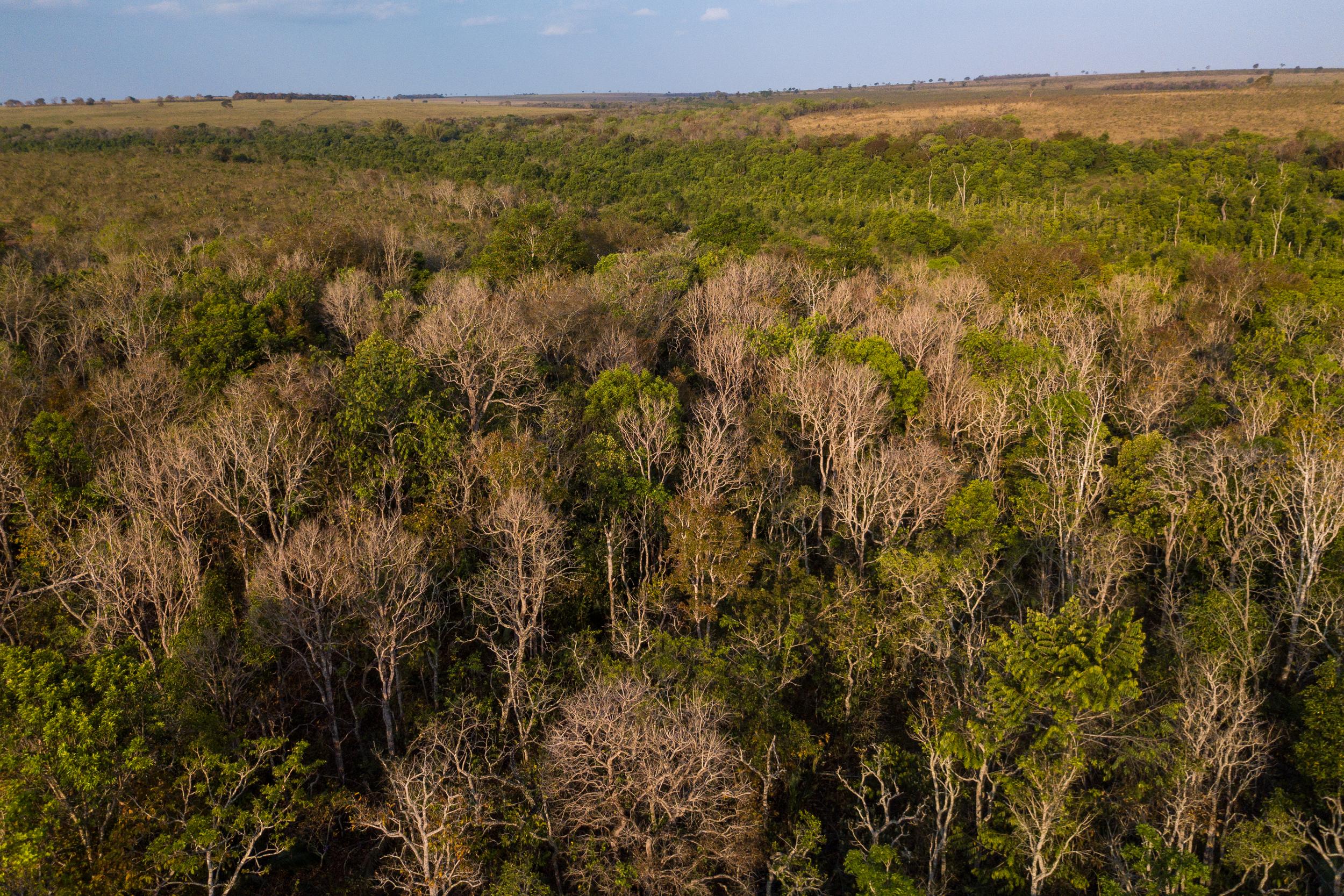
© Flavio Forner
In a landscape dominated by degraded cattle pasture, nature clings for survival in small, fragmented groves.
This is “Project Alpha.” Located in the Brazilian state of Mato Grosso do Sul, it aims to protect and restore nature to an area roughly twice the size of Manhattan — and find new ways to pay for it. Designed by BTG Pactual Timberland Investment Group (TIG) with help from Conservation International, the project has brought together two groups often seen as natural adversaries: conservationists and timber operators.
“It’s easy to form a snap judgment about planting non-native plantations anywhere outside their range, like eucalyptus from Australia,” said Turner, a scientist at Conservation International. “But snap judgment isn’t how we’re going to solve climate change and save biodiversity. We need to test what really works. This is a very serious commitment to improve the way we manage nature within private properties.”
And this property is just the beginning. Over the next five years, TIG plans to secure US$ 1 billion from investors to plant, conserve and restore nearly 275,000 hectares (741,000 acres) of degraded land in Brazil, Uruguay and Chile. In doing so, they plan to capture some 32 million metric tons of climate-warming carbon over a 15-year period, the equivalent of taking 470,000 cars off the road.
Half of the land acquired by TIG will be protected or restored back to its natural state and set aside for conservation, while the other half will be planted with commercial species, like eucalyptus. Not merely a trade-off, where commercial activities fund conservation, the plan represents a unified system where restoring nature provides added value to investors through the sale of carbon credits, while sustainably certified timber revenue helps fund ongoing monitoring and protection of the native forest.
“We’re standing on the line balancing economic production and environmental protection,” Turner said, gesturing down the middle of the road. “It’s a balancing act that could lead to positive outcomes for people and nature in this region — if we can get it right.”
The cost of restoration
The road to Project Alpha from Campo Grande winds northward through hundreds of miles of degraded cattle pasture. Erosion furrows the land, carving deep channels through red earth, the pasture’s vitality withered under the weight of overuse.
It didn’t always look this way.
Half a century ago, southwestern Brazil was a mosaic of closed-canopy forests, open savanna-like woodlands, vast grasslands and wetlands. This region, known as the Cerrado, boasts remarkable biodiversity, harboring 5 percent of the world’s species, including over 1,600 mammals, birds and reptiles, along with over 10,000 plant species — nearly half of which are unique to this region.
“Many assume the Amazon rainforest is Brazil’s most threatened ecosystem, but in reality the Cerrado is even more threatened,” said Rachel Biderman, who leads Conservation International’s work in the Americas. “While the Amazon has lost roughly 13 percent of its area, the Cerrado’s total size has been halved.”
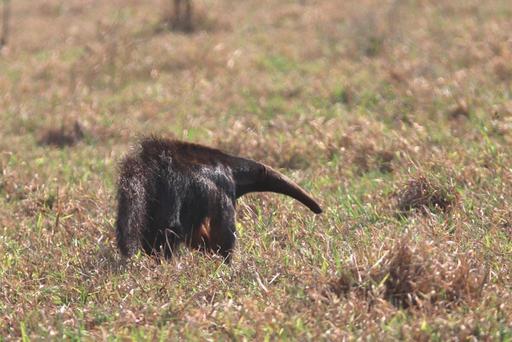
© Will Turner
A giant anteater lopes along the forest’s edge, passing through a field of withered Brachiaria grass.
Substantial portions of the Cerrado have been replaced with Brachiaria, an exotic African grass introduced for cattle grazing. And while Brachiaria has helped Brazil become the world’s leading beef producer, years of overgrazing have degraded the country’s land at a scale that’s difficult to comprehend: By some estimates, 60 million hectares of Brazil’s Brachiaria pastures are suffering from some degree of degradation — an area nearly half the size of neighboring Peru.
“Very few crops will grow in this soil,” Biderman said. “And because of that, almost no one is willing to making investments to return this area to cropland — it’s just too expensive.”
But restoring this degraded land back to the Cerrado is even pricier.
In recent years, an avalanche of well-intentioned marketing campaigns has popularized the idea that forest restoration can be achieved for as little as US$ 1 per tree, sometimes less.
Restoration requires operating across an entire landscape and over decades: planting the right trees in the right place, working with local communities, monitoring conditions to ensure saplings survive. And then there’s the matter of conserving restored forests. The actual costs can amount to thousands of dollars per hectare.
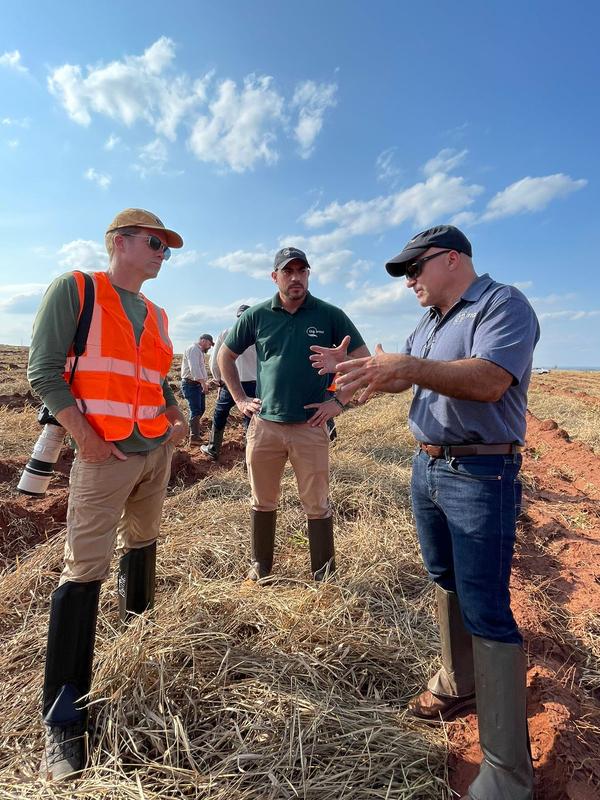
© Tatiana Souza
Will Turner listens as TIG’s Márcio Conceição and Mark Wishnie explain the eucalyptus planting process.
The high cost of restoration reflects a broader challenge: There is nowhere near enough money available from traditional sources — governments, multilaterals and philanthropy — to restore nature at the speed and scale needed to make a dent in climate change.
Climate scientists have demonstrated that at least 30 percent of humanity’s climate targets can be met by protecting and restoring nature — but meeting the target means restoring 200 million hectares (500 million acres) within the next seven years. That’s a monumental scale — roughly the area of all the timberland in the United States.
But a surprising solution is on the horizon — one that could inject US$ 1 billion toward this goal.
Speed and scale
A year after the Timberland Investment Group — owned by the biggest investment bank in Latin America — acquired the land for Project Alpha, this severely degraded expanse of cattle pasture is now poised to include the largest Cerrado restoration project in history.
The restoration area extends from an existing patch of Cerrado forest and follows the swale of the watershed. Here, the woodland is naturally regenerating, its canopy closing in as native species gradually reclaim the land. The vegetation is tenacious, with blooming layers peeking through yellowing Brachiaria grass, which still dominates the broader landscape.
According to Brazilian law, private landowners in the Cerrado must set aside 20 percent of their property as a natural ecosystem. TIG, however, has committed to restoring and protecting 50 percent of the project area, thus opening up an additional revenue stream to fund the project and deliver greater impact, at scale: the sale of carbon credits.
Carbon credits result from initiatives that remove or prevent greenhouse gas emissions and can be purchased by companies to strengthen their climate impact and balance out emissions in other areas. Polluters in developed countries can buy and trade credits, the idea goes, with the revenue being paid to landowners in developing countries as an incentive to regrow their forests and leave them standing.
In June 2024, TIG announced a milestone for the project: they will provide Microsoft with 8 million nature-based carbon credits — the largest carbon dioxide removal deal of all time.
TIG aims to generate carbon credits from both the tree farm and the restoration effort.
“The tree farm is able to help pay for the restoration because it’s really a reciprocal relationship,” said Mark Wishnie, chief sustainability officer and head of impact investment at TIG. “An offset from a tree farm — which is eventually harvested and replanted — has a lower monetary value compared to one from restoration. Therefore, the inclusion of Cerrado restoration boosts the quality and quantity of carbon capture and storage in the project, making the carbon credits more valuable.”
“Over the years, we’ve successfully executed hundreds of thousands of acres of reforestation projects,” Wishnie said. “That means that our operations are well understood and, therefore, investable by large institutional investors. We can get much more finance to restoration by combining it with timber production than we would on its own.”
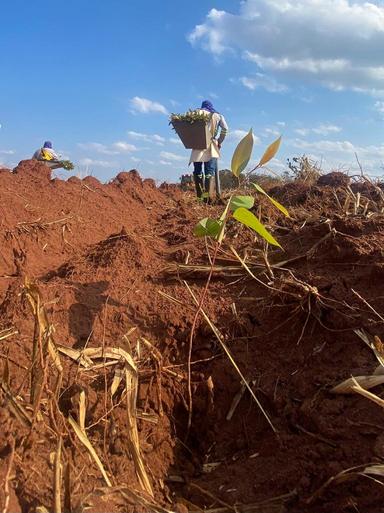
© Will Turner
Eucalyptus saplings can reach up to 70 feet in height in as little as seven years.
Under legal agreements with those investors, TIG has a limited period in which to invest this money — meaning they are motivated to operate at a speed and scale that wouldn’t be possible with a restoration-only project.
And now, they are putting their money where their mouth is. In degraded soil where so little else will grow, the eucalyptus is thriving — growing faster and taller here than in its native Australia. This is the result of decades of purposeful cultivation, involving the careful selection of trees to ensure uniformity, rapid growth and outstanding wood quality.
In just four months, TIG has put 1.9 million eucalyptus seedlings in the ground.
The process is an assembly line of precision, with workers spread across the landscape, depositing identical saplings at exact intervals. By month two, the trees reach the height of a toddler; by six, a full-grown adult. In seven years, they’ll be ready to cut and then replanted — though TIG operates on a long-rotation growing cycle, waiting up to 15 years to harvest them. Those extra years add up to a larger tree, which is not only a more versatile product, but one that stores more carbon — both while it’s alive and after it has been cut.
“The extended growth period leads to larger logs suitable for solid wood products like furniture, which continue to store carbon for much longer than if we cut the trees earlier and used them for paper products,” Wishnie said.
“This is bigger than generating carbon credits for us — we consider the entire production process part of the climate solution.”
The return of the Cerrado
Under a waning afternoon sun, Miguel Moraes watched the ongoing work at Project Alpha through the window of a truck.
As a Conservation International plant ecologist, he has worked for the last 10 years to design restoration projects in Brazil — and is ensuring TIG’s work follows conservation science.
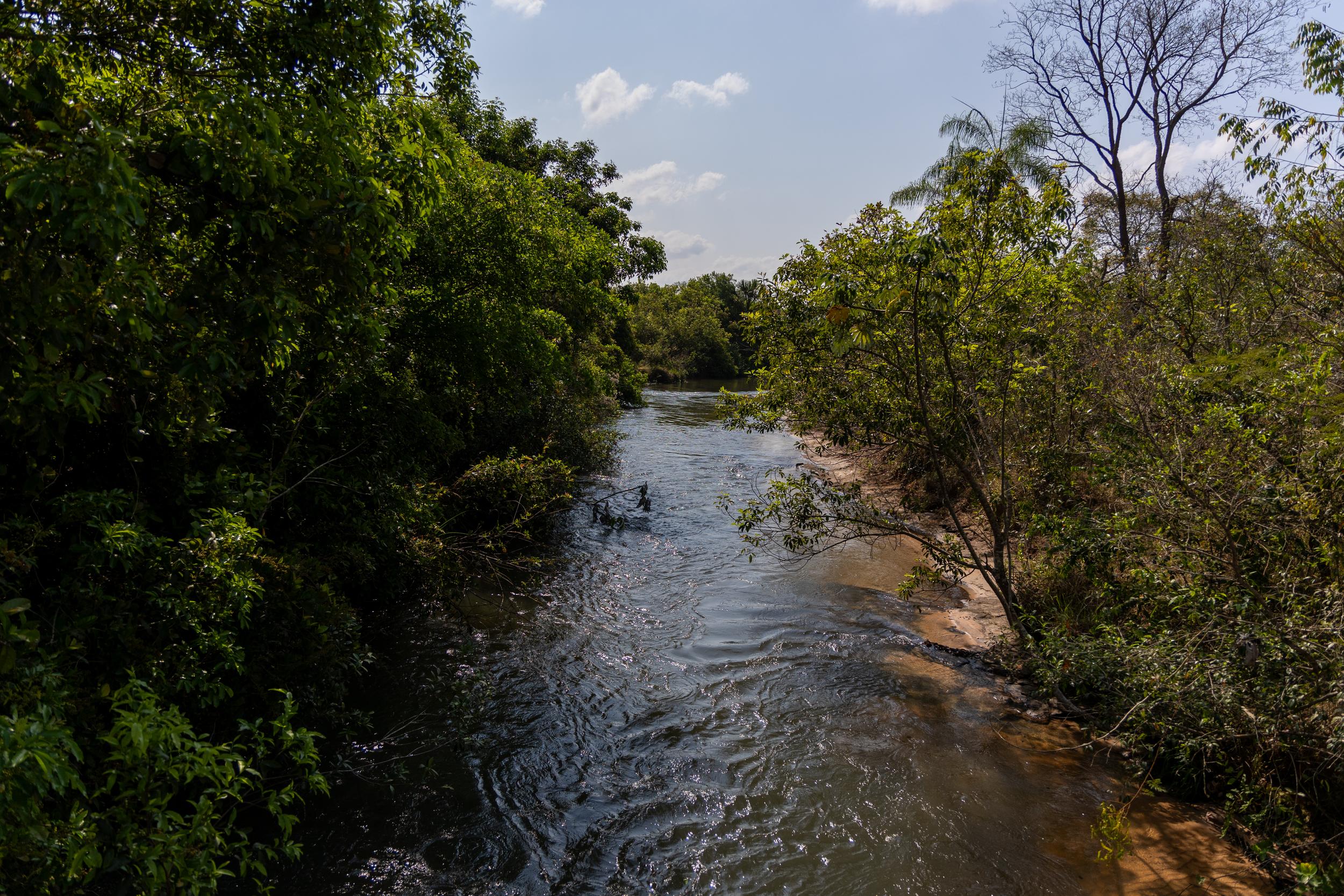
“We’re playing it extra safe to make sure we protect the upper areas of the watershed,” Moraes said, pointing toward a corridor of rapidly regenerating Cerrado. “By law, this river must have a 30-meter buffer of natural vegetation on either side, to prevent run-off. Instead, we’re putting in 200-meter buffers on each side, 400 meters from end to end — four football fields.”
© Flavio Forner
The restoration area is designed to keep the river free of contaminants and create a safe corridor for wildlife.
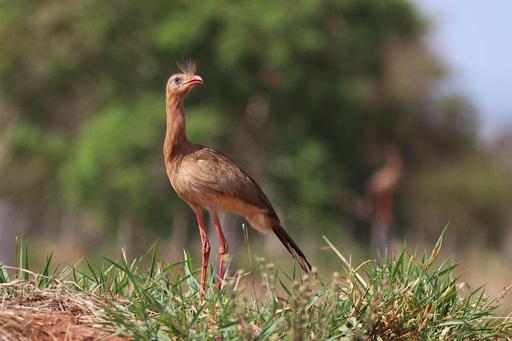
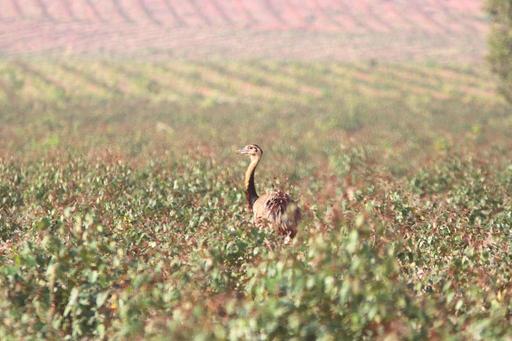
This protected passage not only controls the sediment flow — keeping the river clear of contaminants — but creates a wildlife corridor between the forest and a state-protected reserve. And the wildlife is making a swift return to the area, with sightings of maned wolves, javelinas, giant anteaters, rheas, seriemas, and at least one elusive puma patrolling the forest.
Consensus on how to restore, and where, has emerged through debate and discussion among Moraes, Wishnie — who started his career as a forest restoration scientist at the Smithsonian Institution — and other project leads. All acknowledge that Project Alpha is an experiment — one that will evolve over the 15 years it is expected to require to bring back this overlooked ecosystem.
“You know, I would typically hesitate to advocate for natural regeneration as the primary method for Cerrado restoration,” Moraes said, leaning back in the car’s front seat to address Wishnie. “But this is really compelling — the rapid resurgence of vegetation is remarkable.”
“Yeah, it can certainly be a part of it, right?” Wishnie replied. “When I first visited this property, I was thrilled because this isn’t a sight you come across everywhere. Nature is undeniably reclaiming this land.”
“But we still have to deal with the Brachiaria,” Moraes added.
© Will Turner
Project Alpha has become a haven for wildlife like Seriemas, a striking bird native to the Cerrado.
Many of Moraes and Wishnie’s discussions center on this challenge. They have spent hours excitedly discussing a range of options to outsmart the grass — from cattle grazing to herbicides. Eliminating the Brachiaria infestation is crucial not only because it’s a non-native species but because it exerts an allelopathic effect, inhibiting the germination of other species. It’s possible that seeds from native plants may be dormant in the ground, unable to bloom until the grass is eliminated.
In addition to battling the Brachiaria, TIG has initiated a range of monitoring programs to closely track the property’s conditions. These include biannual wildlife camera traps during the dry and wet seasons, water quality measurements, soil sampling for a carbon assessment and ongoing efforts to launch bioacoustic monitoring — placing microphones to listen for wildlife.
“Sometimes people will initiate a project and discuss monitoring as if it’s a future task,” Conservation International’s Will Turner said. “But here they’ve got monitoring programs already running and built into the budget before commencing the project.”
TIG is also working to understand the living conditions for local people in the region — assessing their access to public transportation, health care, education and even cellphone service. Matto Grosso do Sul is a massive state — around the size of Germany — but has a relatively small population of 2.7 million people, with approximately 1 million residing in the capital, Campo Grande. Beyond the urban centers, communities primarily rely on cattle herding to make a living. Understanding the communities and their relationship with the land is critical to ensure that both the tree farm and restoration efforts benefit the people in the surrounding region.
While only a few families live near the property, Moraes said he doesn’t rule out the possibility of other communities using the forest. The neighboring forest is home to the Quilombola, an Afro-descendant community of former slaves who resisted the centuries-long slavery regime in Brazil.
“These communities might be using the area for seed collecting and other uses,” Moraes said. He points to the potential for developing a conservation agreement with Indigenous or local communities using the forest — enabling them to share in the benefits of the project, while preserving their traditional way of life.
The future of forestry
As dusk settles in, the truck follows the road to leave the property, flanked on one side by the regenerating Cerrado and on the other by the eucalyptus tree farm.
“It’s natural that people should be skeptical and ask why — why do we need to plant eucalyptus trees on this old pasture?” Wishnie said, motioning toward the tree farm. “Why can’t we just restore forests?”
“When most people see a field of corn or soy or wheat, they intuitively recognize the necessity of converting land into exotic monocultures to feed the population. However, a tree farm often evokes a more emotional response because the demand for these materials appears less immediate and less intertwined with our daily lives.”
© Will Turner
A rhea, a flightless bird known as the South American ostrich, moves through the stands of eucalyptus.
But the world is using more wood than ever before. In the past 30 years, the global trade of wood products increased 143 percent, with no signs of slowing down. Meeting this demand will require new sources of sustainably grown wood.
“Eucalyptus presents a viable alternative,” said Conservation International’s Biderman. “In Brazil, the alternative is wood illegally sourced from the Amazon rainforest. Today, we can no longer afford the luxury of prolonged debate. Eucalyptus does indeed have a role to play, when it’s grown responsibly.”
To that end, the collaboration between Conservation International and TIG may offer a blueprint for how sustainable businesses can become integral to the conservation of nature.
“We don’t claim this to be a universal solution,” Wishnie said. “But our commitment lies in making it succeed here. And we’ll never know what’s possible unless we take that step and give it a try.”
Will McCarry is a staff writer at Conservation International. Want to read more stories like this? Sign up for email updates. Also, please consider supporting our critical work.