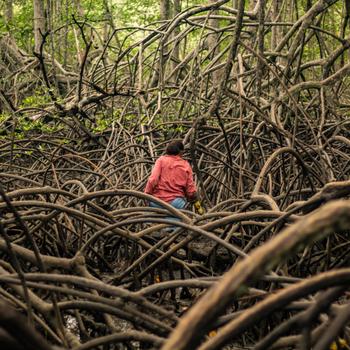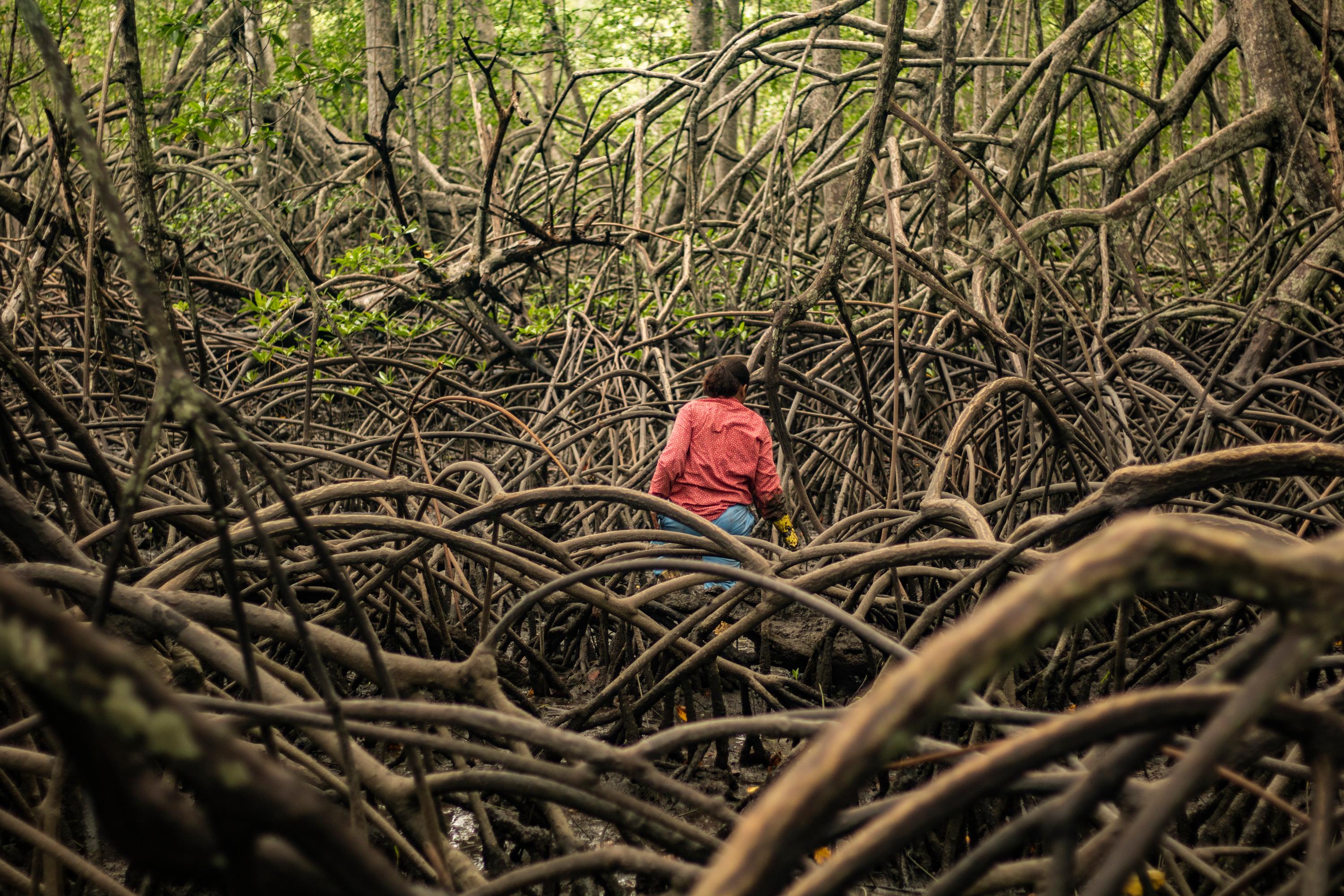
At low tide, Arnold Anzules wades into the mangrove forest, moving carefully through exposed roots. He's a local crabber in Churute, Ecuador, gathering red crab from among the tangled roots — work his community has done for generations.
But as these coastal, salt-tolerant forests disappear, that work is getting harder to sustain. Ecuador has lost nearly a quarter of its mangroves in recent decades, mostly to make way for shrimp farms. The forest Arnold depends on has been shrinking for as long as the industry has been growing.
Now, a government agreement — backed by Conservation International — has formally recognized his community's stewardship over this stretch of the coast and trained them to harvest in a way that keeps the forest healthy. Arnold has learned how to pull a red crab from the mud without tearing up the roots that anchor the riverbank in place. It sounds like a small change, and it is. But multiplied across thousands of harvests a year, it's a difference that adds up.
The stakes reach well past Churute. Mangroves are climate superstars. Once written off as swampy, mosquito-ridden borderland, they're now recognized as some of the planet's most effective carbon sinks. A single square mile of mangrove can lock away as much carbon as 90,000 cars emit in a year. Their interlocking roots are also among the best natural defenses against storm surge and coastal flooding — protection that matters for the nearly 200,000 people living in Ecuador's flood-prone coastal areas.
Beginning in 2024, Conservation International and Ecuador's Ministry of the Environment, Water and Ecological Transition launched a six-year, roughly $46 million project — backed by the Green Climate Fund — to protect and restore mangroves across the country's four major estuaries: the Gulf of Guayaquil, the Jambelí archipelago, the Cayapas-Mataje reserve and the Muisne-Cojimíes estuary. The goal: bring 150,000 hectares under stronger protection, restore nearly 5,000 degraded hectares and help shrimp farms shrink their environmental footprint across 20,000 hectares.
When the project entered its first phase in July 2025, Ecuador had already brought 100,000 hectares of mangrove under the same kind of community stewardship agreement Arnold's group holds. A year later, that had grown to 116,000 hectares. A second track is gaining ground too: 22 communities, covering more than 17,000 additional hectares, have applied to Ecuador's National Forest Conservation Program, Socio Bosque, which pays communities directly to keep native ecosystems standing.
Protecting mangroves is only half the equation. The shrimp industry itself has started restoring forest rather than clearing it. In June 2026, Ecuador's National Aquaculture Chamber and the Sustainable Shrimp Partnership signed an agreement with Conservation International to restore 250 hectares of mangrove inside existing shrimp-farming operations by 2030 — a move projected to absorb around 112,000 tons of carbon, the equivalent of taking more than 26,000 gasoline-fueled cars off the road for a year.
“Shrimp farms have been a major driver of mangrove deforestation, but it doesn't have to be that way,” says Conservation International's Montserrat Albán, who leads the organization's climate work in Ecuador. “With this project, Conservation International and our partners will show that mangroves can thrive in harmony with sustainable shrimping and fishing.”
That's just one piece of a much bigger effort, Albán says.
“Overall, the Mangroves for Climate project will help Ecuador take a big step toward conserving these critical ecosystems — for local people and for the global good.”