Editor’s note: This week Conservation International’s first virtual reality film, “Valen’s Reef,” debuted at the Cannes Lions International Festival of Creativity; watch the film here. Its spectacular setting — eastern Indonesia’s Bird’s Head region — contains some of the most species-rich waters on Earth; it could also hold clues for how to help our oceans adapt to climate change. Conservation International marine scientist Mark Erdmann explains.
In recent months, numerous reports in the media have exposed the alarming levels of climate change-induced coral bleaching on Australia’s Great Barrier Reef and many other locales across the Pacific Ocean. Aerial surveys suggest that over 93 percent of the Great Barrier Reef has been affected by bleaching, and Australian experts warn that in many areas this bleaching is so severe that it will likely result in 50 to 90 percent mortality of corals.
Indeed, many coral scientists are lamenting that coral-dominated reef systems as we know them will cease to exist within the next few decades — a shift that could spell the end for a number of fisheries and marine tourism industries and cause significant economic hardship and food security problems for tropical countries around the globe.
The overall trend is clear; we must address climate change now or prepare to face a very different world than we now enjoy. However, I also feel compelled to note that there are “bright spots” in our oceans, and that we do still have time to act and conserve some of our most important marine ecosystems.
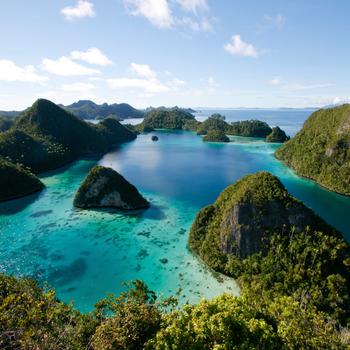
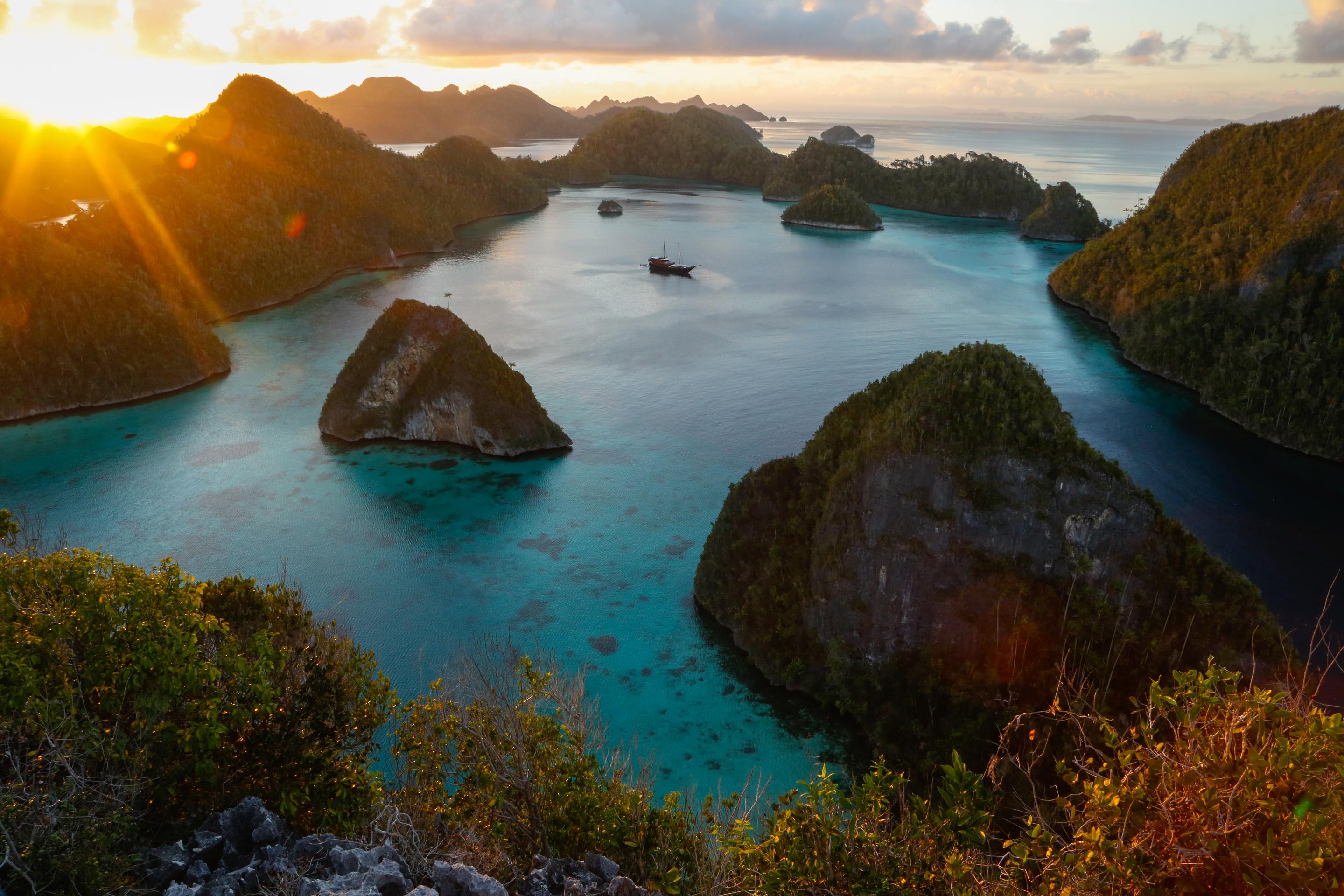
I’ve just come back from a two-week expedition in Raja Ampat, an archipelago within eastern Indonesia’s Bird’s Head Seascape, and I’m pleased to report that our team saw scant evidence of bleaching in the global epicenter of marine biodiversity. (See the thriving coral reefs for yourself courtesy of this footage from Blue Sphere Media’s Shawn Heinrichs.)
While bleaching has been severe in other parts of Indonesia, Raja’s reefs are healthy and thriving. What’s their secret?
Undoubtedly the reasons for Raja’s resilient reefs are complex and numerous, but we believe that one of the most important factors is that its reefs are normally exposed to a wide variation in temperatures, basically “pre-adapting” them to climate change. We’ve been monitoring ocean temperatures in the Bird’s Head Seascape since 2005 with a set of 78 temperature loggers that measure temperature every 15 minutes and record it onto a computer chip. Through this work, we’ve identified a number of reef areas which are regularly exposed to oceanographic upwellings of deep cold water, as well as a number of healthy shallow reefs which are literally “cooked” every day at low tide by waters super-heated by the sun.
What we’ve learned is rather incredible: Reefs across Raja Ampat experience temperatures fluctuating between 19 and 36 degrees Celsius (66–96 degrees Fahrenheit), with many individual reefs exposed to a whopping 6–12 C variation within a single 24-hour period! According to most marine biology textbooks, such variation should easily kill these corals, yet they are thriving.
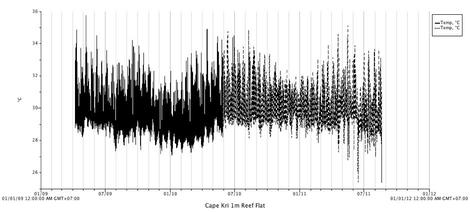
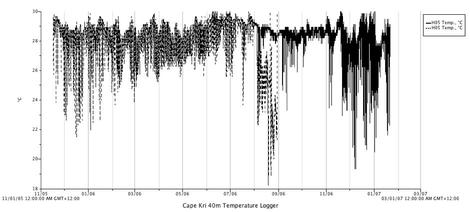
Examples of the data retrieved from temperature loggers placed at 1-meter (3.3-foot) depth (above) and 40-meter (131-foot) depth (below) on the reef at Cape Kri in Indonesia’s Raja Ampat archipelago. While these loggers are both in areas of healthy coral and are only separated by a distance of around 200 meters (656 feet), they are exposed to vastly different temperature regimes.
Exactly how these large temperature variations effect Raja’s reefs is not fully known, but colleagues of mine such as Dr. Andrew Baker at University of Miami and Dr. Stephen Palumbi at Stanford University have been studying this phenomenon in other regions and have provided important insights. Baker made headlines around the world in 2001 when he showed that coral bleaching was likely an adaptive response, whereby corals exposed to stress such as unusually warmer waters will expel the symbiotic algae (called “zooxanthellae”) which live in their tissue in a bid to replace these algae with other strains that are more heat tolerant.
Key to this insight was the prior discovery that these zooxanthellae (once believed to be a single species) are actually quite genetically diverse, and that different species have different thermal tolerances. Baker, Palumbi and colleagues have shown that reefs exposed to warmer waters tend to have more heat-tolerant zooxanthellae in their tissue.
Further reading
What does this mean in a super diverse reef system like Raja Ampat, where there is such large variability in temperatures? Well, we assume that, like the corals themselves, the symbiotic algae in Raja Ampat are likely very diverse – with some strains performing best in cooler waters and others quite tolerant to super-heated reef flat waters. This means that Raja Ampat’s reefs are not only resilient and able to readily bounce back from any bleaching that might happen, but also that these reefs are likely to be increasingly important in the future as a genetic repository for heat-tolerant zooxanthellae — potentially serving as watery “seed banks” for restoration efforts on other reefs that succumb fully to coral bleaching.
Knowing how special and important Raja Ampat’s reefs are, CI has worked with local communities and the government to give priority protection to reef areas that are exposed to either cold-water upwellings or regular high temperatures. These reefs have been placed in strict “no-take” zones within Raja Ampat’s network of seven large marine parks, to ensure that they are given the highest possible protection to safeguard them from other disturbances (including overfishing) that might compromise their resilience.
Overall, this protection has been working — which is one reason we chose this teeming patch of ocean as the subject of CI’s first virtual reality film, “Valen’s Reef.” I hope that as more people than ever before get to simulate diving in this spectacular setting, they will see for themselves what a healthy reef looks like — and, in the face of the massive damage occurring on reefs elsewhere, be more motivated to help us protect this rare jewel. After all, it may hold the key to how we can help other corals survive in the world we’ve created.
Mark Erdmann is CI’s vice president for Asia-Pacific marine programs, now based in Auckland after 23 years in Indonesia. “ Valen’s Reef” was created in partnership with leading virtual reality production company Vrse.work and made possible with support from The Tiffany & Co. Foundation.