A roadmap for people, nature and climate
A roadmap for people, nature and climate
Date of publication: April 2026
Produced by:
In partnership with:

Lead Authors:
Perushan Rajah, Virginia Gorsevski, Sally Archibald, Heidi-Jayne
Hawkins, Joana Krieger, Daniel Myers, Kavya Pradhan, Timothy ‘Max’ Wright, and Kim Zoeller
Within Africa’s landscapes and seascapes lies the potential not only to safeguard the continent’s future, but to inspire the world through opportunity and hope … The time for coordinated, strategic action is now – and Africa is ready to lead.
Executive Summary
Africa’s contribution to the causes of global climate change is minimal, but its people and iconic natural capital face disproportionate impacts that impede sustainable development and compromise continental sovereignty. Africa’s ecosystems, if appropriately protected, managed, and restored, can support people and nature while simultaneously contributing to global efforts to reach net zero emissions from nature by 2050.
Led by African scientists who give a voice to the continent’s priorities and needs, Africa’s Nature Transition: A Roadmap for People, Nature, and Climate (hereafter referred to as the Africa Roadmap) establishes the continent’s position as a solutions provider and investment destination in the global climate response. It describes how unified efforts to leverage nature as a proven climate solution can build resilience, mitigate climate change, and provide critical co-benefits to ensure a prosperous and just nature transition. Importantly, the Africa Roadmap is aligned with the African Union’s Agenda 2063, which outlines a vision for inclusive and sustainable development across Africa, emphasizing that integrated efforts to protect biodiversity, water, food security, human well-being, and climate resilience lead to better outcomes.
The aim of the Africa Roadmap is to accelerate action and investment in climate mitigation across sub-Saharan Africa by aligning global climate ambitions with the region’s key priorities and needs, avoiding perverse outcomes, and emphasizing both carbon and non-carbon benefits across livelihoods, biodiversity, climate adaptation, water, and food security. The Africa Roadmap supports governments to identify and maximize opportunities to reform national policies to embed nature-focused targets within key national guidance documents, such as nationally determined contributions, national adaptation plans, and national biodiversity strategy and action plans.
Furthermore, the Africa Roadmap seeks to catalyze local and national stakeholders and international actors into action to support natural climate solutions – but to do so in a way that is guided by six key principles that ensure due consideration is given to people, nature and climate, thereby increasing the likelihood of adoption and durability.
These principles are:
1
Acknowledge Africa’s development priorities and needs
2
Allocate financial resources to solutions that generate the biggest co-benefits
3
Prioritize solutions that maintain options for the future
4
Be transparent about opportunity costs and trade-offs associated with interventions
5
Implement interventions with the greatest degree of local buy-in about the desired future state
6
Use data that accurately reflect the situation in Africa
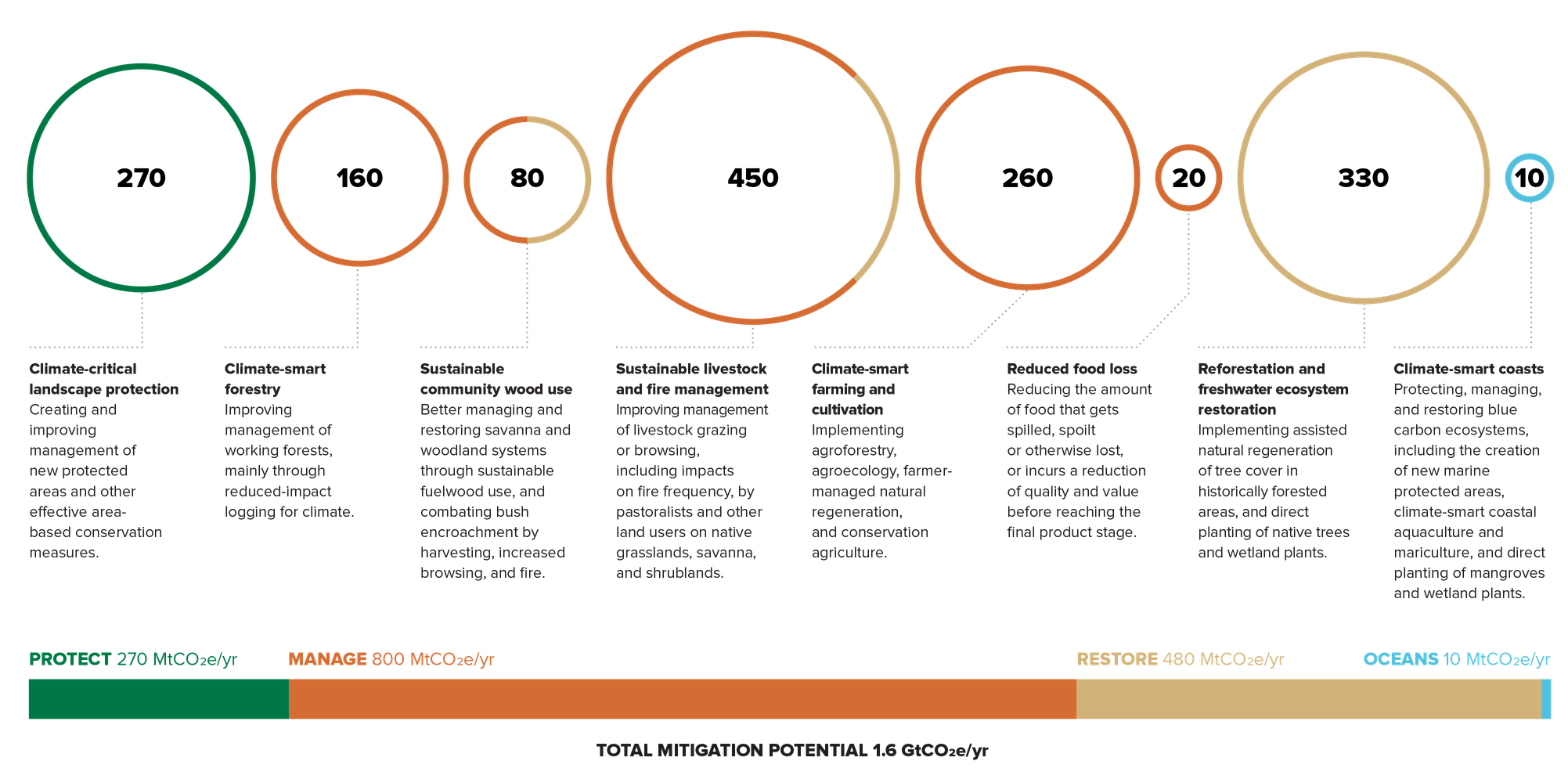
Africa Roadmap Action Tracks showing technical carbon mitigation potential (MtCO2e/yr)