January 29, 2026
ARLINGTON, Va. (Jan. 29, 2026) – Restoring forests near freshwater ecosystems globally could sequester up to 3.41 gigatonnes of planet-warming carbon dioxide annually, according to new research published today in Nature Water by Conservation International, NASA and Khalifa University.
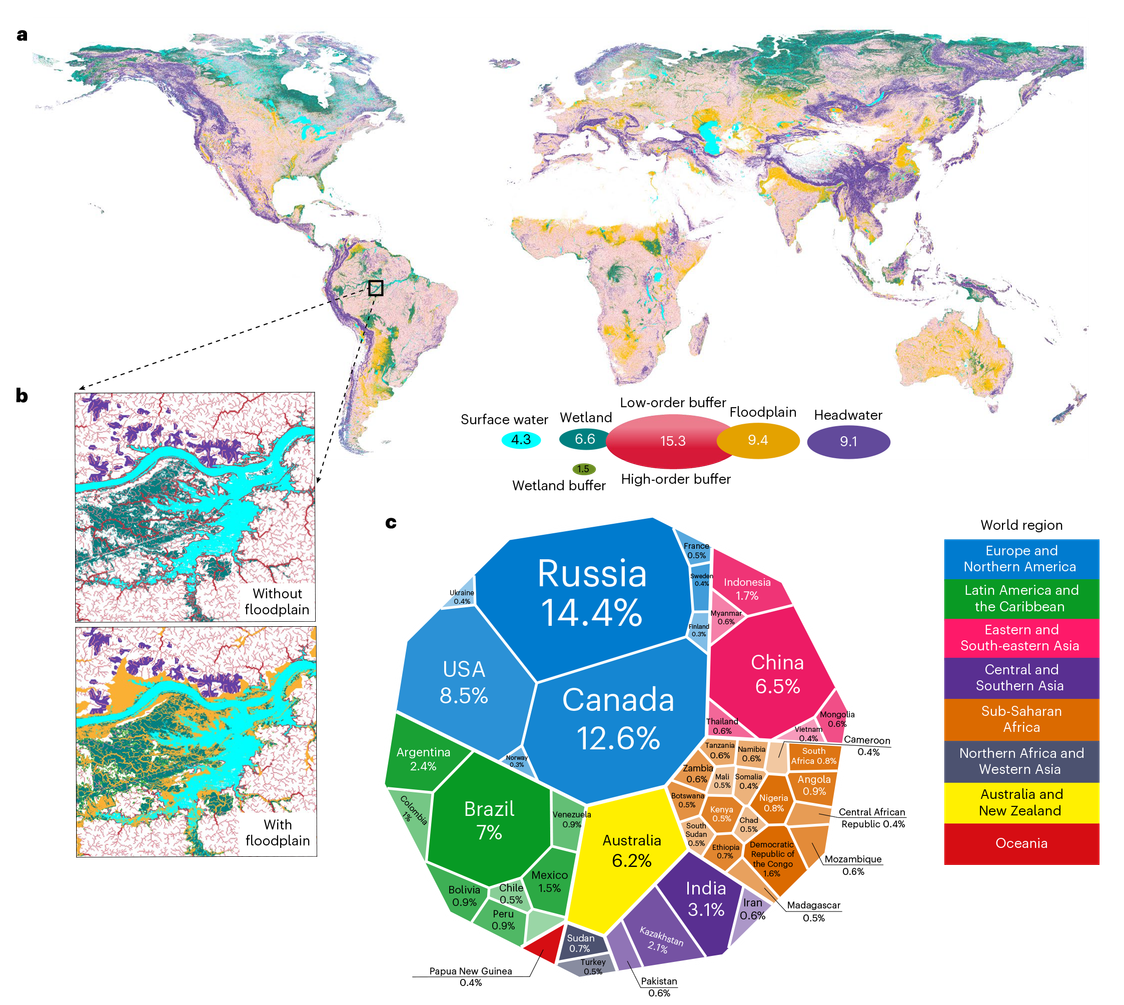
Worldwide, High Value Freshwater Ecosystems (HVFEs) constitute over 5.16 billion hectares of rivers, lakes, reservoirs, floodplains, riparian buffers, wetlands, peatlands and headwater catchments. This group of ecosystems heavily influences global water flow, filtration and storage, as well as biodiversity. The newresearch published today maps the globe’s HVFEs for the first time.
The study finds that restoring naturally occurring forests within these HVFE areas could yield between 1.07 and 3.41 gigatonnes of additional global carbon storage each year, depending on the extent of restoration.
Sequestering 3.41 gigatonnes of carbon dioxide would be equivalent to halting emissions from 900 coal-fired power plants for a year. Climate experts suggest that an annual net loss of 1.4 gigatonnes is the rate we must achieve if humanity is to reach net zero emissions by 2050.
Despite their substantial role in storing the planet’s carbon, freshwater ecosystems are among the most threatened globally, declining by an extent of 70% over the last century.
Their potential as a nature-based climate solution – one that would aid in achieving global climate and biodiversity goals – could be significantly improved by targeted restoration efforts. The study published today identifies priority areas where these efforts would have the greatest climate impact.
“Most Nationally Determined Contributions and National Adaptation Plans talk about water, but they rarely specify where to act. Our framework translates those high-level ambitions into specific rivers, floodplains, and riparian zones that countries can actually put on a map and integrate into their plans,” said co-lead author of the study, Mahya Hashemi, Research Scientist with NASA Goddard Space Flight Center.
The regions whose HFVEs have the highest restoration potential to store planet-warming carbon:
- Latin America and the Caribbean (279.9 million hectares to be restored)
- Southeast/East Asia (229.7 million hectares)
- Europe and North America (114.9 million hectares)
“By pinpointing where degraded land overlaps with high-value freshwater ecosystems, in this study, we show exactly where restoration can possibly deliver the greatest returns for flood protection, water quality, and carbon sequestration,” said Hashemi.
“These systems cover the world, and they are often in need of restoration.We took the current land use into account when planning for restoration, which specifically targets deforested lands in forest regions.While forest restoration would give maximum environmental benefits, there is also the option to establish new agroforestry in these degraded areas, if agricultural production is needed in those areas, and either of those approaches can provide major climate mitigation” said co-author Starry Sprenkle-Hyppolite, Senior Director of Restoration Science with Conservation International.
“Restoration will look different for freshwater ecosystems in different parts of the world. Some efforts require active interventions like reconnecting a river to its floodplain, while others are just lacking official protections or appropriate zoning,” said Kashif Shaad, Conservation International’s Director of Freshwater Science and Sustainability, co-lead author of the study.
Some countries are already working toward the restoration and preservation of freshwater ecosystems through voluntary efforts like the Freshwater Challenge, which supports the goal of restoring 350 million hectares of degraded wetlands by 2030. Two of the countries with the most HVFE area – Brazil and Canada – are already Freshwater Challenge participants, but other nations with some of the highest concentrations of HVFEs are not. As of today, more than 50 countries have committed to the Freshwater Challenge; they constitute over 44% of HVFEs worldwide.
“Every local stream or lake is part of a bigger picture when it comes to freshwater management,” said Shaad. “While the bodies of water themselves are often geographically fragmented, our conservation efforts cannot be if we hope to reach these ecosystems’ full potential for carbon storage and climate mitigation. It must be a global team effort to protect these important places around the world.”
###
About Conservation International: Conservation International protects nature for the benefit of humanity. Through science, policy, fieldwork and finance, we spotlight and secure the most important places in nature for the climate, for biodiversity and for people. With offices in 30 countries and projects in more than 100 countries, Conservation International partners with governments, companies, civil society, Indigenous Peoples and local communities to help people and nature thrive together. Go to Conservation.org for more, and follow our work on From the Field, Facebook, Twitter, TikTok, Instagram and YouTube.