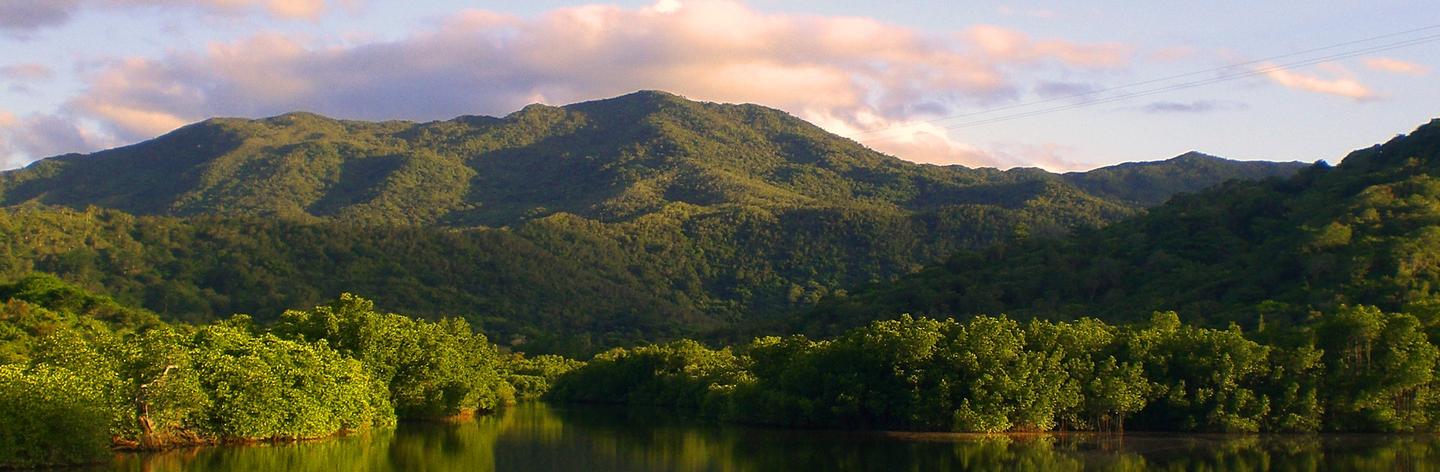
Despite the increasing knowledge of amphibians and reptiles in Guyana, the southern part of the country has yet to be explored. Southern Guyana has been noted as a high research priority because it harbors large, contiguous forests, and a high diversity of habitats. The reptiles and amphibians of the Acarai Mountains and the upper Essequibo River had never been surveyed before this expedition.
Methods
Sampling for reptiles and amphibians took place in the rivers and tributaries and in the nearby vegetation, with the exception of occasional findings by the other RAP team members (usually the insect team). Adult and juvenile amphibians and reptiles were captured by hand once seen, while tadpoles were collected using fine mesh nets (occasionally by the fish team).
 |
Blue poison dart frog (Dendrobates tinctorum). |
The team also interviewed local field guides informally, who were able to provide information especially about medium-to-large reptiles.
Results
The study area yielded 26 species of amphibians and 34 species of reptiles. Most of the amphibians were of the order Anura, of which over half were tree-frogs. Toads and poison arrow frogs were found in smaller numbers. Within reptiles, the team recorded two species of crocodilians, three turtles, 14 lizards, and 16 snakes. All of the large reptiles, including two species of crocodiles and three of turtles, are part of the Wai-Wai diet.

Most of the sampling effort was devoted to areas of importance to the Wai-Wai, or near to their village. Overall, the results showed only a fraction of the amphibians and reptiles found in the area and more work should be undertaken to determine its true richness. Many of the amphibians found were species generally associated with habitat affected by human activity.
IN DEPTH: Learn more about reptiles and amphibians of the Konashen, Guyana.
 |
Schneider's dwarf caiman (Paleosuchus trigonatus) young, this species prefers more turbid waters than other species of the genus. |
This includes such species as the common cane toad
Chaunus marinus, the smooth sided toad
Rhaebo guttatus, the black spotted skink
Mabuya nigropuntata, the bridled gecko
Gonatodes humeralis, and turnip tailed gecko
Thecadactylus rapicauda.
These species were found in the houses, and whiptail lizards Ameiva ameiva and Kentropix calcarata were found at sites nearby.
Interesting Species
 |
Worm lizard (Amphisbaena vanzolinii) is legless and without functional eyes. |
The blind snake
Typhlophis ayarzaguenai represents the first record of this species for Guyana. An aquatic lizard, the snake
Helicops sp., and the caecilian may also represent new records for Guyana, once taxonomic review is completed. The caecilian was found only in the non-flooded forest of the Acarai Mountains. Monkey frogs of the genus
Phyllomedusa were also found in this area.
In the Kamoa River area, two species were found that were unique to that area; the crested forest toad (Bufo margaritifera) and the chicken frog (Leptodactylus knudseni).
What it Means
 |
| Emerald tree boa (Corallus caninus) coiled in a tree. |
Since the expedition was conducted only during the dry season, there are undoubtedly many more species to discover in this region. The Acarai Mountains and Sipu River area is likely the richest in the Konashen COCA for reptiles and amphibians.
The elevation ranges and unique habitats, including non-flooded forest and mountain streams, probably harbor many endemic and undescribed species, making it very important for future research.
Although the area of Konashen closest to the villages showed much less abundance of medium-to-large reptiles, many of which are part of the Wai-Wai diet, the other reptile and amphibian communities appeared to be in good shape.
| Ant Team | Dung Beetle Team | Katydid Team | Fish Team |
| Reptile and Amphibian Team | Bird Team | Mammal Team |