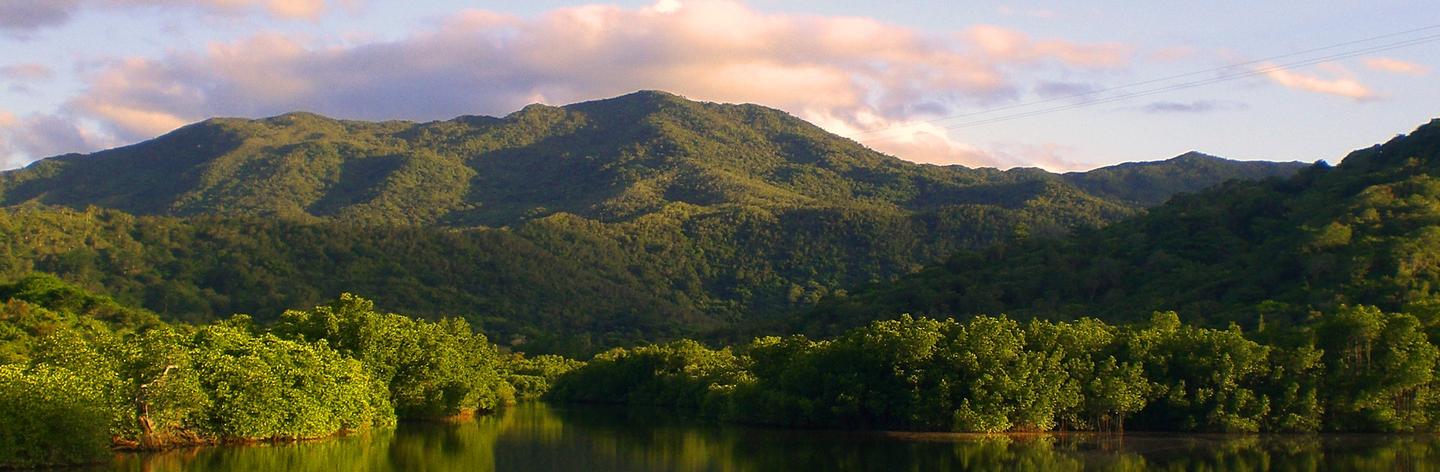
I gained a new appreciation for dust on my trip to our training site at Pibiri Creek, 51 km south of Mabura Hill township. A timber company created Mabura Hill to house the loggers working here in what is now a forest concession for conservation. A forest concession is when the government offers to lease land to a company for commercial use. In this case, Conservation International obtained a forest concession from the government of Guyana with a plan to lease the land to protect the forest rather than to use it to extract timber.
 |
|
Fixing a flat on the road to Pibiri Creek. |
LEARN MORE: Guyana, world's first conservation concession.
The road out to Mabura Hill is a maroon color because of the iron rich clay. It's the dry season, so every logging truck that passes us kicks up a blinding cloud of dust into our packed land rovers. When we get out to stretch our legs (actually to fix one in a series of flat tires), we laugh as the sweat turns the dust back to clay on our faces.
The idea behind this RAP is to train Guyanese students to form a local, long-term RAP team. RAP expert scientists hold class in the jungle, teaching about RAP methods. Vice versa, the students educate the scientists about the local names for
 |
Scientists and students work into the night. |
the forest's flora and fauna. We even look for nocturnal signs of life.
TOOLS: Discover some of the equipment and techniques used by scientists in the field.
Our camp is in a small clearing in the jungle, and with 25 people underfoot all sharing a creek to bathe, it is hard to remember that we are in the middle of nowhere. Wildlife is all around: first a hurricane of howler monkeys then capuchins and spider monkeys. We see jaguar tracks and tiny red brocket deer hoof prints on the ground (guess how that relationship works out!). We walk through
 |
| Students during training session. |
the forest and a student gasps, "peccaries!" Peccaries are wild pigs prone to attack anyone so I do some quick calculations on how long it would take me to learn how to climb trees. Luckily, the pigs never came and put me to the test.
ISSUES: Learn about the threats to trees and the ecosystems of Guyana.
Now that the initial training part of this trip is over, students who can will join us for the rest of the RAP Expedition in the Kanuku Mountains. The RAP team leaves Pibiri Creek and heads for the actual scientific research in the mountains tomorrow.
The adventure continues, so bye for now.
See you next in the Kanukus!
<< About the Expedition | Day 1 Dispatch >>