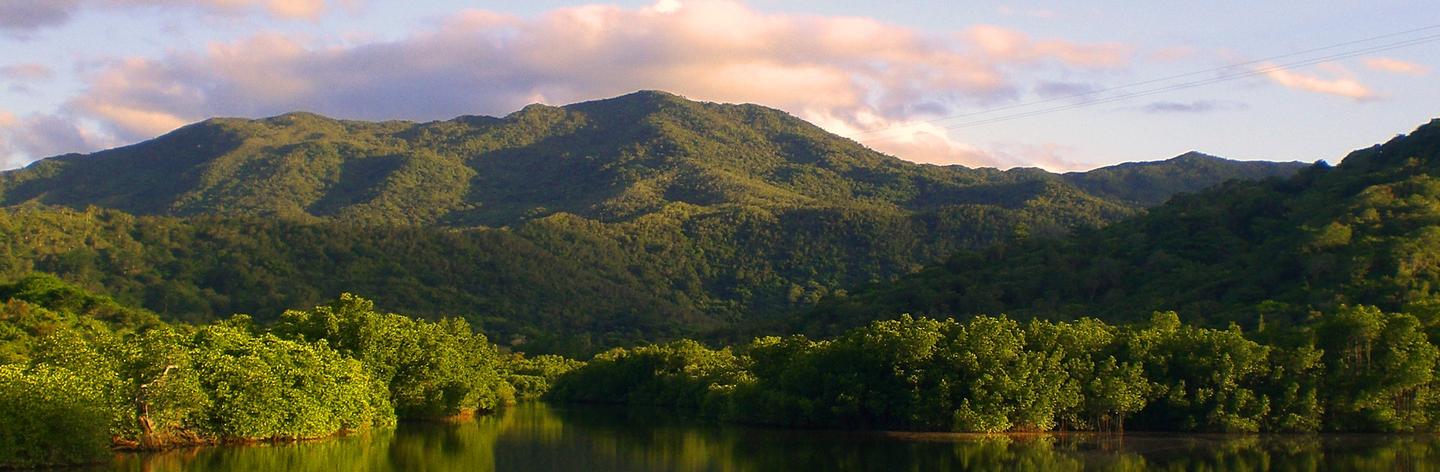
Both India and Sri Lanka have a long history of environmental protection and reverence for nature. What are perhaps the oldest reserves in the world were created in this region, with one in the dry zone of Sri Lanka dating to about 200 BC. In both nations, there is a strong civil society presence in conservation. In total, around 26,000 km², or 13.8 percent of the hotspot area, is under official protection, about 11 percent of which is in categories I-IV.
WESTERN GHATS
India has a long history of conservation and environmental legislation, complimented by a protected area system that is more than a century old. In 1980, the Forest Conservation Act was enacted, providing an important means of biodiversity protection for the entire nation. This act states that forested land cannot be used for any purpose without approval by the central government. As a result, all legal logging operations in the hotspot were halted in the mid-1980s.
The national and state governments provide the majority of conservation investment in India. For instance, the State Forest Departments work towards managing forests, conserving biodiversity, reforestation, and social forestry. The Ministry of Environment and Forests, the Planning Commission, and other agencies invest in environmental projects nationwide. Multilateral and bilateral donor agencies, including the World Bank, the Asian Development Bank, and the international development agencies of Japan, the United States, the United Kingdom, and other nations provide loans and grants to both the government and to research institutions and NGOs. Many national, regional, and local NGOs actively participate in biodiversity conservation, particularly through the involvement of communities in sustainable natural resource utilization. While research institutions and NGOs have access to much lower amounts of funding than the government agencies, their work tends to be more targeted towards biodiversity conservation.
Less than fifteen percent of the Western Ghats is protected in 20 national parks and 68 sanctuaries. Considering IUCN categories I-IV, which offer a higher level of protection, the figure drops to around 11percent, according to the World Database on Protected Areas. Thus, the protected area network is far from complete. One way of ensuring that the network of protected areas adequately conserves biodiversity is through the identification and conservation of "Key Biodiversity Areas" (KBAs). These are globally important sites for biodiversity conservation, defined by the presence of irreplaceable and threatened biodiversity: globally threatened species, restricted-range species, and species that concentrate in globally significant numbers. KBAs are biologically meaningful units that can be potentially managed for conservation, defined in a bottom-up, data driven process.
The identification of KBAs in the Western Ghats was initiated in 2003, coordinated locally by Ashoka Trust for Research in Ecology and the Environment (ATREE), and in collaboration with The Wildlife Conservation Society-India and the University of Agricultural Sciences in Bangalore. Building from preliminary data on Important Bird Areas, compiled by the Bombay Natural History Society, data on globally threatened species of mammals, birds, amphibians, plants, and to a lesser extent, reptiles and fish, were synthesized to identify and delineate 126 KBAs in the Western Ghats. These sites are high priorities for conservation action. KBAs in the Western Ghats will be refined as new and better data become available. Landscape-scale action, through biodiversity conservation corridors, will be necessary for wide ranging species such as the Asian elephant (Elephas maximus, EN), tiger (Panthera tigris, EN), Asiatic wild dog (Cuon alpinus, EN), and greater spotted eagle (Aquila clanga, VU).
SRI LANKA
In the Sri Lankan portion of the hotspot, most of the remaining habitat is officially protected by the Forest Department (FD) and the Department of Wildlife Conservation (DWLC). These areas include national parks, strict nature reserves, jungle corridors, and sanctuaries. Approximately 30 percent of the nation’s land area falls under some level of natural resource management.
One of the most important reserves in the hotspot is the Sinharaja Forest Reserve, which encompasses 50 percent of the remaining lowland rainforest vegetation in Sri Lanka. Portions of the reserve have been protected since 1875, and it was declared a World Heritage Site in 1989. Sixty-five percent of Sri Lanka's 220 endemic tree and woody climber species and 270 species of vertebrates have been recorded there. Although public awareness of Sinharaja's splendid biodiversity is growing, the reserve still faces threats. People from neighboring villages encroach on the reserve via logging roads to collect non-timber forest products.
In Sri Lanka, 92 Key Biodiversity Areas have been identified through a process coordinated by the Wildlife Heritage Trust of Sri Lanka and the University of Peradeniya, and involving a number of experts. Data on Important Bird Areas compiled by the Field Ornithology Group of Sri Lanka were incorporated into the analysis, along with published literature on species distributions, herbarium records, the 1996 National Conservation Review inventory of forest reserves, and other data for the remaining taxonomic groups. Nearly all of these KBAs are forest patches in the southwestern wet zone. All sites contain endemic species that are found nowhere else, and are therefore considered irreplaceable, with several sites having more than 100 globally threatened species. All of these sites technically have some form of protection, but there is a tremendous need to strengthen the management and monitoring of these areas. Additionally, landscape-scale conservation, particularly reforestation and conservation of biological corridors, will be required for biodiversity to persist in this severely fragmented region, even in the short term.
The flora and fauna of Sri Lanka are greatly understudied; for instance, in 2004 alone, a new species of owl, the Serendib scops owl (Otus thilohoffmanni), was described and nine other bird species added to the list of endemics. Thus, the number of endemic species is likely to be a gross underestimate, and the list of key biodiversity areas delineated will have to be modified as new data become available.
As in India, the bulk of conservation investment is by the government. In general, conservation investment by the government has focused on law enforcement, resulting in the alienation of some communities in the vicinity of protected areas. More recent projects have aimed to rectify this by involving and aiding communities in the vicinity of protected areas. Other current projects target capacity building. Multilateral and bilateral donors include the governments of the Netherlands and the United States, and the Global Environment Facility. The only international conservation organization with a base in Sri Lanka is the World Conservation Union (IUCN), which has worked with the government to develop a national Red List of threatened species, and helped to develop a national strategy for biodiversity conservation. Investment by civil society institutions has largely focused on environmental education and advocacy.