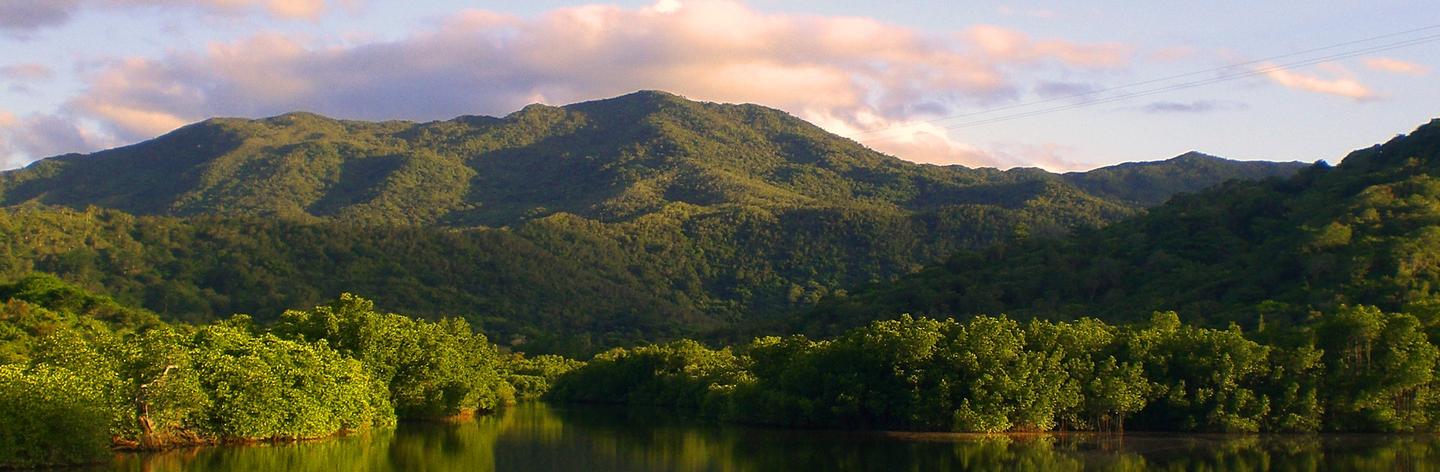
The Guinean Forests of West Africa hotspot is one of the most critically fragmented regions on the planet. Only 93,047 km², or 15 percent, of its original forest cover remains. Much of this remaining forest is exploited for timber or threatened by hunting and does not represent intact habitat.
Forest conversion for cultivation, which began thousands of years ago in the region, was exacerbated during colonial times, when forests were commercially exploited for large-scale logging and agricultural plantations (e.g., oil palm, rubber) were established. Illegal logging is on the rise in the region; for example, Ghana can sustainably produce about one million cubic meters of timber from its forest reserves and agricultural lands, yet in 2002, there were 3.7 million cubic meters' worth of logs extracted, about four times the annual allowable harvest.
Commercial agriculture in West Africa has historically been followed by slash-and-burn agriculture, which has exacted the greatest toll on the region's forests. The practice of clearing, cultivating and then letting land lie fallow is widespread is the major source of livelihood for the rural population. With human population exploding in the region, fallow periods are becoming shorter and the demand for richer soils provided by the remaining 'pristine' forested land, including that in parks and reserves, is constantly on the rise. This situation is further aggravated by the influx of farmers from arid northern Africa.
At current annual growth rates, populations in all the West African countries are expected to double by 2025. Although projected population increases will not necessarily be concentrated within the remaining forest, the resulting demand for forested land will increase dramatically, and the pressure on existing protected areas will become more severe.
Large-scale mining for iron ore, diamonds, gold, and bauxite, particularly in montane areas, and small-scale mining for gold and diamonds also pose a major threat to the forests. Furthermore, in many areas, loggers, miners and other introduced populations further stress the forest resources through hunting of wild animals, particularly antelope and primates. Bushmeat hunting is an important source of protein for rural West Africa and yet also one of the greatest threats to the region's fauna. Growing urban populations, improved road networks, and increased access to forests have created a huge commercialized trading system for it both nationally and internationally. Numerous studies have indicated that the bushmeat trade in the region is enormous; estimates of its value in Ghana run as high as US$400 million per year and for Côte d'Ivoire, US$500 million. Bushmeat hunting is even a problem in forests reserves because of the lack of capacity for enforcement or protective laws. If not controlled it may eventually lead to "Empty Forest Syndrome," where the forest looks structurally undisturbed but is totally or nearly totally devoid of larger mammals.
Political instability and civil conflict, complicated by weak and inefficient governance, have also exacerbated the threats to standing forests in West Africa. More than a million refugees from civil wars and persecution in Liberia and Sierra Leone have fled to forests in neighboring countries, increasing the pressures on the forests for food, fuelwood, building materials, and water. This number has increased significantly in recent years with the outbreak of conflict in Côte d'Ivoire.
Threats to biodiversity in the region are inextricably linked to poverty, which drives urgent short-term needs that often eliminate long-term opportunities. Much of the livelihood of the region's population is closely dependent on, or not far removed from, the natural resource base. Unemployment and weak development of human capital often stimulates social unrest, human migration, ethnic tension, and land-tenure conflicts, frequently near forested lands. Lack of access to health care has reduced work force productivity and promoted the spread of HIV and AIDS. Infrastructure for education, communication and commerce is limited and inadequately maintained. This lack of public investment and personal opportunity challenges efforts to raise and maintain institutional capacity for conservation in government agencies, NGOs and communities.