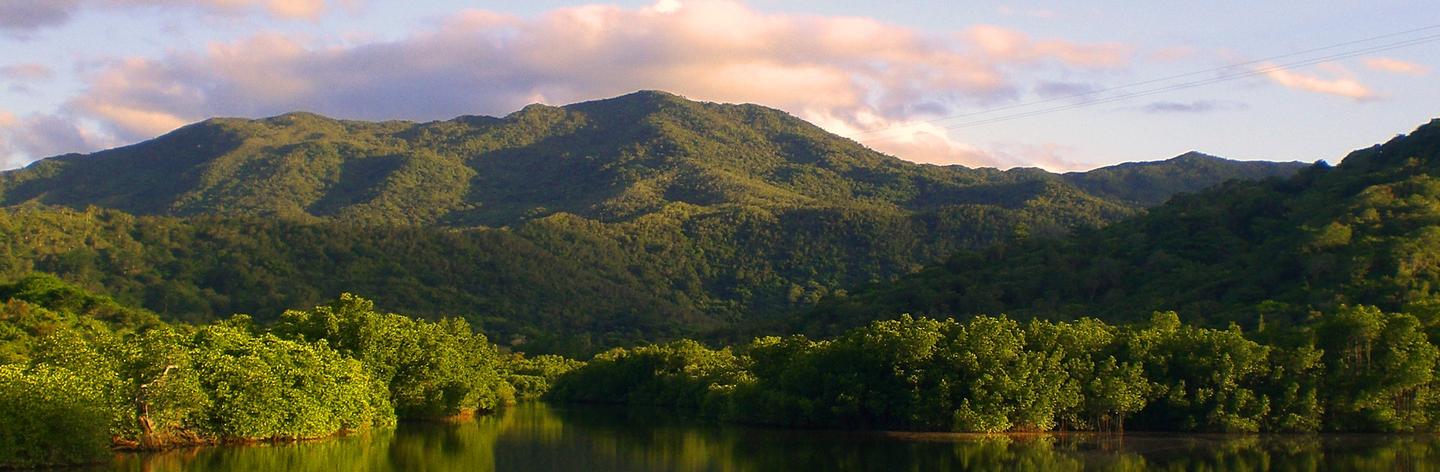
Working together in chiapas

Made in the Shade

CI Connection Working in Chiapas with farmers like Aguilar, CI and Starbucks developed guidelines for ethical sourcing that recognize farmers for growing coffee in a way that's better for both people and the planet. These practices are now in use by over a million farmers on four continents.

September 30, 2011
It all starts on the ground in the mountain chain of the Sierra Madre de Chiapas, where farmers make a simple but profound choice: whether to grow their coffee in harmony — or at odds — with nature.

For Ausencio Aguilar, the choice is a natural one.

"Nature gives us everything for free, if we know how to treat her right," says Aguilar, an organic coffee farmer in Sierra Morena, a small coffee community in the Mexican state of Chiapas. (For more of Aguilar's perspective in his own words, watch the video above).

What farmers like Aguilar — who follows the Coffee and Farmer Equity (C.A.F.E.) Practices guidelines developed by Conservation International and Starbucks — find is that by treating nature right, they are ensuring their own livelihoods.

In Chiapas, one of the most important coffee-growing regions in Mexico, that means growing coffee in the time-honored, traditional way: in the shade of native trees. 

For Aguilar, it means a deep connection to the land and all that it provides him. You will find no chemical fertilizers or insecticides on his farm; instead, his coffee plants are mulched by composted coffee berries and the leaves that fall to the forest floor, and they are fertilized — and kept pest-free — by the birds and other animals that thrive in the natural habitat he lovingly maintains. Beneath the leafy canopy, the result is an exquisite shade-grown coffee that matures more slowly — but which yields a richer, fuller flavor as a result.

In days past, growing coffee this way was the norm. But as the global demand for coffee grew steadily over the 20th century, the traditional, sustainable methods of growing coffee increasingly gave way to the production of coffee in the sun. The prevailing wisdom was that by clearing forested slopes, more coffee plants could be grown.

But coffee, which thrives naturally in mixed tropical forest settings and allows farmers to diversify their income by growing other crops as well, doesn't fit so easily into the same monoculture approach as staples like corn and wheat.

Yes, in the short term, coffee can be grown in the sun — and faster, at that — but the process demands greater intervention and resources on the part of the farmer. Sun-grown coffee requires much more water and the use of chemical fertilizers and pesticides — all of which degrade the local environment, threaten the health of both people and wildlife, and ultimately yield what is widely considered a lesser product.

Farmers who grow their coffee in the sun must constantly try to bend nature to their will. But as Aguilar, who has been bringing his organic, shade-grown coffee to market for 10 years with the help of CI and Starbucks, has long known, looking after nature is the best way to look after ourselves.

"We learn little by little," he says, "and today we know that not harming nature gives us life. We eat well, and we take care of everything."

And everything, in turn, takes care of us.


Next: learn what the birds on Aguilar's farm do for us: The Birds and the Beans »

gradient separator

Coffee and Farmer Equity (C.A.F.E.) Practices

Sometimes, doing the right thing pays big dividends.

The conventional wisdom might say that what's good for the planet is not necessarily good for business. But, through Coffee and Farmer Equity (C.A.F.E.) Practices, Starbucks and Conservation International have demonstrated that the ethical sourcing of coffee can have a lasting, positive impact — not only on the environment, but on the lives of coffee growing communities and on the bottom line as well.

Read more...


why
this
matters

After oil, coffee is the most heavily traded commodity in the world — but not all coffee is created equal. By choosing ethically sourced coffee, our individual actions together can change lives, livelihoods — even the planet itself.


what
can
ido?

Choose sustainable coffee. Find out how »

Use the power of your computer to fight climate change. Learn more »


gradient separator

Give now

Support CI's work in Chiapas and around the world.

Donate Now »

gradient separator