Ecosystem services and biodiversity play a crucial role in the sustainable development of Fiji's economy.
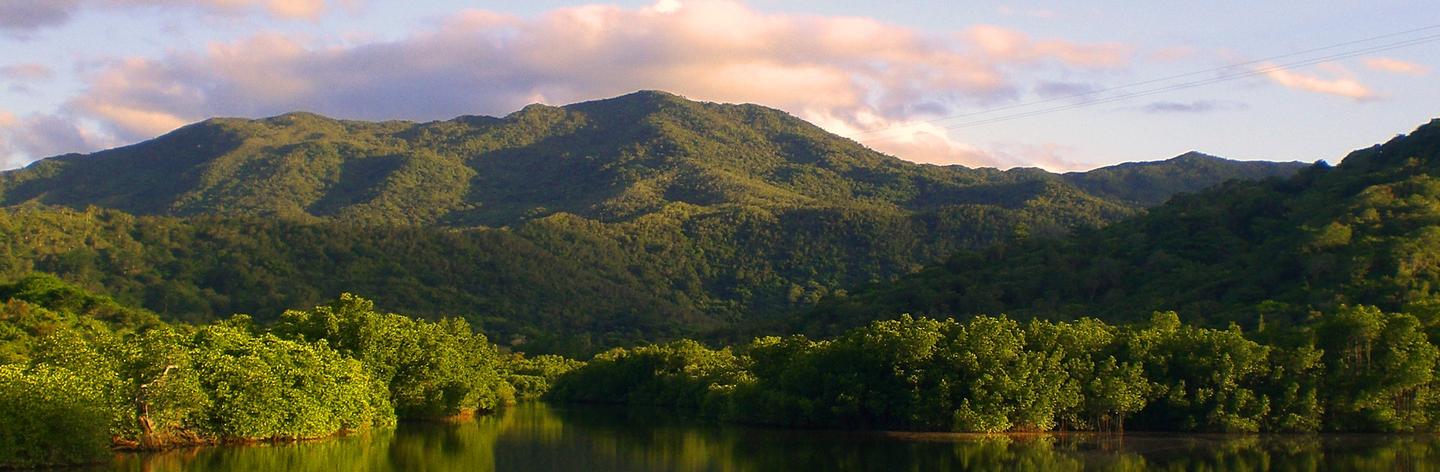
CI's work in Fiji focuses on Viti Levu, the country's largest island and home to 70 percent of Fiji's population (approximately 590,000 residents). It is a volcanic island about the size of the Big Island of Hawai'i and is divided in half by a north-south mountain. The prevailing southeast tradewinds result in a "wet" eastern side and a "dry" western side. Much of the eastern side is still covered in forest while the dry west is mostly arid grassland used for sugarcane production or grazing. Tourism, Fiji's largest economic sector, is concentrated along the coastline of western Viti Levu.
IN DEPTH: Discover how ecotourism can benefit both people and nature.
The forests of Viti Levu are under pressure from logging and conversion to agriculture. A total of 87 percent of the land in Fiji is communally owned by indigenous owners, and by law these lands cannot be sold – they can only be leased. As a result, most conservation and development initiatives are subject to the consent of indigenous resource owners.
CI's activities are focused on where we can have the greatest impact on issues that are most closely aligned with the nexus of healthy ecosystems, ecosystem services and human well-being. Specifically, we're working towards the establishment of the Viti Levu Conservation Corridor – a network of linked terrestrial protected areas and locally managed marine areas – because it provides the foundation on which to achieve our twin objectives of conservation and human well-being.
The establishment of the 20,000-hectare (nearly 50,000 acres) Sovi Basin Protected Area through a 99-year lease with Sovi Basin landowners is the first step in establishing the Viti Levu Conservation Corridor. The Sovi Basin Trust Fund ensures financing to meet all obligations and activities under the lease such as accounting for foregone timber royalties, providing community development opportunities and implementing the co-management plan for the protected area. The lease addresses landowners' food needs by allowing them to continue to use the protected area for traditional food-gathering and fishing purposes. This is the largest contiguous lease ever granted in Fiji and therefore represents an important step toward developing an innovative mechanism for conserving habitat while providing economic and social benefits.
LEARN MORE: Developing Responsible Land Use
Our work in Fiji took an important turn when we partnered with FIJI Water, a premier bottled water supplier. FIJI Water and CI's Global Conservation Fund established and endowed the Sovi Basin Trust Fund to ensure sustainable financing for the Sovi Basin Protected Areas as well as to expand the approach to other nationally significant watersheds. In its efforts to become carbon negative and to reduce its impact on the environment and on climate, FIJI Water is also investing in a portfolio of verifiable and permanent forest carbon initiatives. The goal is that these initiatives will exceed FIJI Water's product life cycle CO2 emissions by 20 percent. CI is assisting FIJI Water to achieve its carbon negative targets through community afforestation projects.
In addition to the human benefits that this program is providing, CI's work has had additional positive consequences. Since 2005, CI has supported a scholarship program for the Sovi Basin's landowning indigenous communities – the program has helped more than 150 students to date. The number of Sovi Basin students in higher education programs has grown from two to over 20 since 2005, including a female student who is now in her third year of medical school.
The work in Fiji is an example of CI's ability to demonstrate success through designing and implementing a pioneering conservation tool on the ground and then scaling up the impacts through strong partnerships.
READ MORE: On Fiji Island: Scholarships