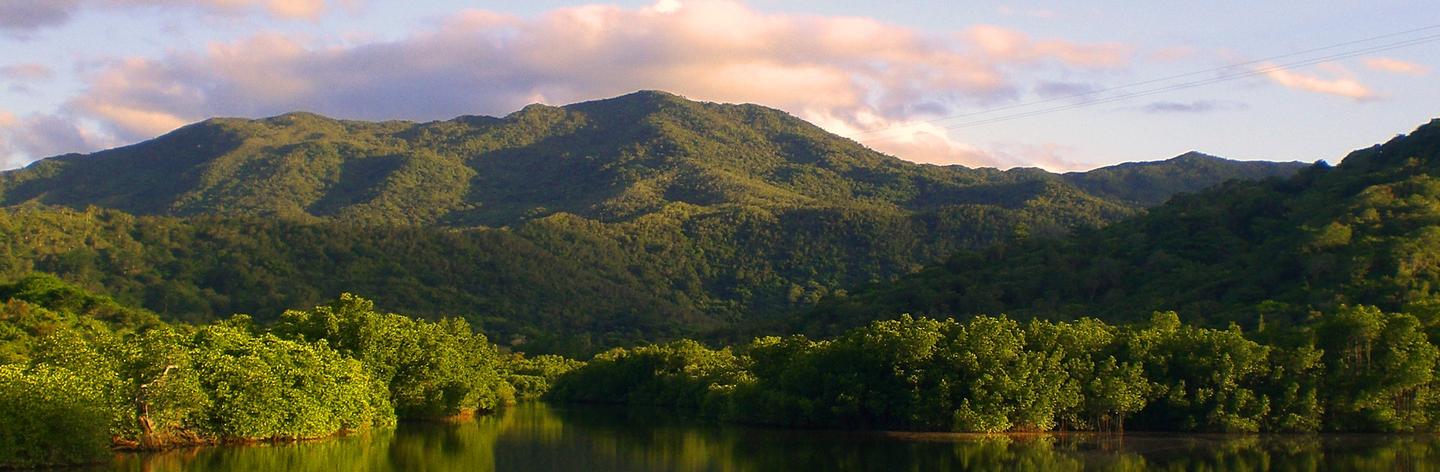
I thought this morning that not much was going to happen today. Breakfast was late, and no one seemed to mind. Everyone was taking a little longer to get started. Things are winding down a bit because tomorrow is our last day here. Eventually, the different groups trickled out of camp and into the forest.
The herp team was photographing some cool animals they found last night, including a
 |
| An undescribed species of tree frog, Litoria sp., discovered by the herp team near Camp Ikan Biru. © Debbie Gowensmith |
probable new species of tree frog. The frog is bright green, almost chartreuse. It has wonderful pads on its toes that enable it to do fun things like hang upside down from your hand by one foot.
Right at noon, a yell broke through the heat and aroused everyone gathered back at camp for lunch. One of the local guides came running and shouting.
They'd spotted a death adder, one of the deadliest and most feared snakes in New Guinea. Steve put on rubber boots to protect his feet from a bite and convinced the guide, who did not want to have anything to do with the snake, to show him where the snake had been seen.
While Steve was gone, I asked Yance de Fretes, "How poisonous is this snake?"
"One little bite, and you're dead in within an hour," Yance answered grimly.
I began to think Steve should have stayed at camp.
 |
| The toxins from this death adder can kill humans within an hour. © Debbie Gowensmith |
But a few minutes later, he slowly walked into camp with a writhing grey snake in his hand. He held the snake just behind the head and made it clear that we should all keep our distance.
One brush with a deadly creature was enough excitement for me for one day, but just then we spotted several guides crossing the stream. One was carrying something large around his shoulders. As he neared camp, the "something large" took shape: a crocodile.
The guide grinned proudly as he walked into the crowd to show us a crocodile about three feet long. He had caught the croc just upstream. Near the place I'd been walking alone a few days ago.
The crocodile was beautiful – a creamy belly edged with olive plates that spiked in a ridge down the croc's back. Steve, death adder still in hand, asked for Burhan Tjaturadi to measure the croc and record data. The guides had placed a rubber band around the croc's mouth, and I hoped it would hold when Burhan held the tape measure to the animal's snout.
 |
"The guides had placed a rubber band around the croc's mouth, and I hoped it would hold when Burhan held the tape measure to the animal's snout." |
| The local guides caught a young freshwater crocodile that had walked through camp the previous night. © Debbie Gowensmith |
Usually the animals the herp team is looking for don't just waltz into camp. Every night, the team wears headlamps into the darkness of the forest.
When I followed the herp team, I first noticed the sounds. Insects and frogs and night birds chirped incessantly from every direction. I couldn't tell the difference between the taxa, but the herpetologists could. They knew just which sounds to ignore and just which sounds to search out.
We all worked together to find one vocal frog. Working in a loose circle, we'd wait and listen for the frog to call. When it did, we'd all shine our flashlights on the spot we thought the call was coming from; this narrowed the area until eventually we had encircled a small piece of forest floor. Then we crouched down to gently sift through the leaf litter carpeting the forest.
While searching, Steve bumped his shoulder on low tree branch. Suddenly, he called out, "Wasps! Run!"
We ran from the immediate area, leaving the frog far behind. I shined my flashlight on Steve, whose back was covered with dozens of small black wasps. We brushed them off, but not before he'd been stung multiple times.
A few wasp stings didn't stop Steve, though. We continued down the trail. Headlamps and flashlights lit patches of forest in erratic patterns.
The rainless night yielded a couple of small lizards.We didn't meet again the wily frog that had been in cahoots with the wasps.
 |
| A giant soft-shelled turtle found near Camp Ikan Biru. © Debbie Gowensmith |
We weren't the only group out and about. A group of guides had been along the stream and had found a giant soft-shelled turtle. Unlike most turtles, these have soft, almost spongy bellies. The top shell felt not hard, but cartilaginous like a human ear or nose. These turtles can grow to a couple of feet long. Though no one knows how old they can grow, Djoko Iskandar ventured an educated guess of fifty to sixty years. "We're not sure how old they can get because humans and crocodiles like to eat them," Djoko explained.
Which reminded me again that I was walking through crocodile country. And that reminded me that I was also walking through death adder country.
No, not a quiet, uneventful day after all. On a rapid survey, it never is.
- Reported by Debbie Gowensmith
<< Day 8 Dispatch | Day 10 Dispatch >>