After five days of surveying the forest around Dabra Camp 1, the teams have a good picture of the area's biodiversity. So today we moved to a second location. It's on the other side of Dabra, off the Tiri River.
For a typical rapid survey of four to six weeks, several sites within different habitats – especially different elevations – would be chosen. This results in a more complete picture of an area's biodiversity since different organisms live in different habitats. Because this survey is even more rapid and is also an extension of the training course, the new site is at only a slightly different elevation. As we packed up Dabra Camp 1 early this morning, everyone was hypothesizing about whether the second site will yield different results.
|
"I was surprised at how open the forest was under that canopy of trees." |
The skies were dumping for the move, so we packed soggy tents and soggy clothes into soggy bags and hiked through soggy mud to the canoes.
The canoes deposited us in Dabra. The two-hour-plus hike to the second site took us through the village of Dabra, up through the village gardens, over several slick logs acting as bridges, and up a mountain. The Dabra side of the mountain had been heavily used-trees cut for housing, canoes, and firewood; gardens planted; a system of footpaths developed. At the top of the mountain, a grassy plateau just large enough for ten to sit beckoned us to rest.
 |
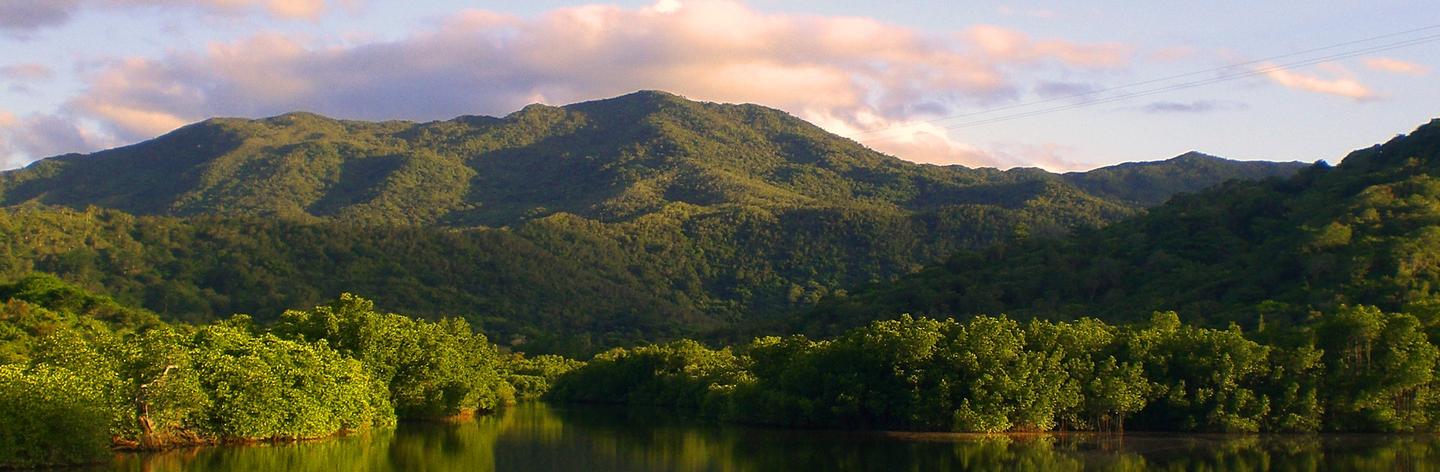
| Forest and Tiri River tributary near our second camp. © Debbie Gowensmith |
The rain stopped. From the plateau I could see a scene through the trees that looked like another world: distant dark mountains wreathed with misty clouds.
The other side of the plateau was also like another world. Instead of gardens, trees reached to the sky and shadowed the forest with gray-green light. I was surprised at how open the forest was under that canopy of trees.
"Wow, what a gorgeous forest," Steve Richards murmured. Dan Polhemus explained that a high canopy layer and an open understory is indicative of a healthy forest. Forests in which many trees have been cut down allow more light to seep through, resulting in a tangled mess of smaller trees and vines near the forest floor.
Just as we'd noticed in the forest at Dabra Camp 1, however, the forest is getting a lot of use. We met about a dozen residents along the trail, some carrying guns and bows for hunting, some carrying loads of sweet potatoes or dead birds.
When we reached the bottom of the mountain, we were halfway through our hike. We made our way through more gardens, a tiny forest village, the main branch of the Tiri River, and then along one of its streams. Though the color of the stream is olive green and brown like the stream at Dabra Camp 1, sandy banks edged this stream. Dan noticed some interesting rocks and handed one to me. "Hornsfels," he told me. "Volcanic rock. And I see a lot of white marble, too. This stream seems to be geologically different from the Furu. Could be interesting."
 |
"In these streams – unlike the streams of the Furu – Jerry found the Melanotaenia praecox, the neon blue fish that his pilot friend had found." |
| Our second camp for the Mamberamo survey is fondly known as "Camp Ikan Biru." © Debbie Gowensmith |
Our new camp is situated on the sandy banks of a Tiri stream. Trees arc upward from both sides of the stream, leaving bare a swath of sky just above us. The stream is gurgling through the middle of camp. Just as occurred when we first reached Dabra Camp 1, personal comforts were addressed and then the taxonomic teams spent the rest of the late afternoon scouting for survey sites.
Jerry Allen and Paulus Boli came here two days before the rest of us because Jerry had to leave for home today. They've erected a small sign christening this site Camp Ikan Biru, or Camp Blue Fish. In these streams – unlike the streams of the Furu – Jerry found the Melanotaenia praecox, the neon blue fish that his pilot friend had found. Yep, this site could be interesting.
- Reported by Debbie Gowensmith
<< Day 5 Dispatch | Day 7 Dispatch >>