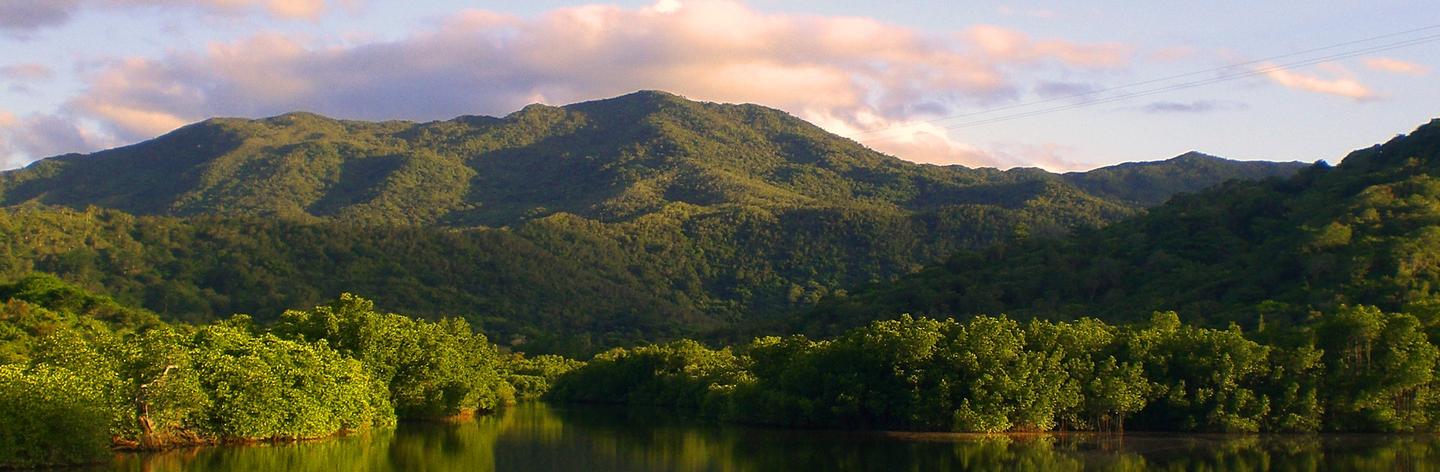
At 3:30 AM, Rose Singadan and Freddy Pattiselanno are up and getting ready to start the day. They gather their flashlights and cotton bags and head into the moonlit forest to check the mist nets for bats.
By the time they return, around 5:30 AM, Bas van Balen, David Kalo, and Suer Suryadi are gathering binoculars, special recording equipment, field notebooks, and bird books to watch and listen for the morning's birds. Their optimum time in the field is dawn, and they'll also check the mist nets for early morning fliers.
Seven bats flew into the mist nets during the day's first hours, so Rose and Freddy get straight to work weighing and measuring and recording the other data for each bat. Rose murmurs softly to each bat as she works, inciting calmness. Rose and Freddy have finished only with one bat when a breakfast of white rice and Ramen noodles with bits of canned salmon is set out at 7 AM
 |
"They take photos of each animal, and I help by standing guard to catch frogs that aren't feeling photogenic." |
| Stephen Richards photographs a possible new species of frog, Litoria nr. arfakiana, © Debbie Gowensmith |
Most of camp is awake now. After a quick breakfast, the plant group – Ismail, Yance de Fretes, and Elisa Wally – head into the forest to begin surveying Whitakker plots. Because the forest supports too many trees for each one to be recorded, these specially arranged plots help the plant team sample a number of trees that will represent the plant fauna of this area of the forest.
Dan Polhemus, the aquatic insects specialist, soon follows, wading in hip boots up the Furu. Dan carries a net and several vials of diluted alcohol, and he'll spend the day scooping aquatic insects like damselflies and dragonflies from every kind of aquatic habitat he can find into his net.
|
Brother Henk helps me learn numbers in Bahasa Indonesia by counting the orange sweat bees crawling on the back of my shirt. "Satu, dua, tiga..." |
The fish specialist, Jerry Allen, has returned from indulging his latest hobby, bird watching. He and Paulus Boli gather several different sizes and types of nets, plastic bags, and snorkel masks. Then they disappear after Dan up the river.
Meanwhile, Freddy leaves Rose, who continues working with the bats, and walks into the forest to check the live traps. Rose and Freddy have alternately placed roasted coconut and roasted fish in the traps, and they're eager to see if any mammals have responded.
Brother Henk van Mastrigt and Edy Michelis Rosariyanto have been waiting for good butterfly weather conditions. Just after 9 AM, they get what they want – lots of sun breaking through and dissipating the night's cloud cover. As the sun intensifies, so do the insects at camp. Several species of
 |
| Fish team with seine nets, © Debbie Gowensmith |
flies and bees hover around everything – damp T-shirts hanging on a vine to dry, a bottle of sweetened soy sauce left on the table from breakfast, and people. Before heading out to survey butterflies, Brother Henk helps me learn numbers in Bahasa Indonesia by counting the orange sweat bees crawling on the back of my shirt. "Satu, dua, tiga..." up to "duapuluh dua" – twenty-two bees. As I swat bees, Brother Henk and Edy grab their nets and go.
The herpetology team – Steve Richards, Djoko Iskandar, and Burhan Tjaturadi – begins processing the frogs and lizards and geckos found the previous night. They take photos of each animal, and I help by standing guard to catch frogs that aren't feeling photogenic. This attracts quite a crowd as the local residents we've
hired as cooks, porters, and guides laugh at a particularly energetic lizard who keeps jumping off a limb and directly into my left hand.
After the photo session, the herp team tromps away from camp to search for those snakes and lizards more amenable to sunshine.
Freddy has found one rat and lots and lots of ants in the more than seventy live traps he and Rose set out. The rat needs to be weighed and measured, and the traps will have to be cleaned of ants. Rose and Freddy spend the rest of the afternoon hunched over their specimens, brushing away intrusive insects.
Lunchtime at camp seems to be the quietest part of the day. Most of the teams are still in the forest, working. While occasional laughter from the cooks drifts across the stream, the most prominent sounds by far come from the forest itself. The cicadas sound like the violin section of an orchestra warming up. Other insects chirp. Birds call. Bees hum.
Groups trickle back to camp between 1:30 PM to 3:30 PM After hours of hiking through mud, over slippery rocks and tree roots, and between hanging limbs and vines, each group still has a load of work to do – identifying species, preparing specimens, taking photos, recording data. Other than grabbing a bite to eat
 |
| RAP participants sit under tarps to complete their late-afternoon specimen work, © Debbie Gowensmith |
(more rice and noodles) and splashing in the stream to cool off, everyone is focusing on the work to be done. It can't be put off because the forest's darkness will soon envelop the camp and because the whole cycle must begin anew tomorrow. On a rapid survey, there's no such thing as "later."
Dinner – rice and noodles with fresh green beans and carp – is set out at 6:30 PM, and it's nearly pitch dark. The orchestra of cicadas quiets, but other chirping insects and frogs begin their nightly serenade. With the slightly cooler air, mosquitoes replace the bees and flies.
The night's work begins. A white sheet strung up by its four corners at the edge of camp is lit by a lamp, attracting kupu-kupu malam, or "night butterflies." Brother Henk and Eddie record the moths gathered there. At 9 PM, the forest swallows Rose and Freddy, flashlights leading the way, to check the mist nets for bats. The herp team members, who are not
|
On a rapid survey, there's no such thing as "later." |
getting the desired rain that makes frogs feel more social, don headlamps anyway and begin their nightly search.
Everyone else at camp either gathers in circles to chat – finally a moment to just relax – or crawls into tents or mosquito nets to sleep.
The herp team returns at about 1 AM, the light from their headlamps cutting through the trees as they enter the dark and dormant camp. They are wet and muddy from slushing through the forest's damp habitats. Three frogs and two lizards will wait in bags till the light of morning.
At 3:30 AM, Rose and Freddy are up again, getting ready to start the day.
- Reported by Debbie Gowensmith
<< Day 2 Dispatch | Day 4 Dispatch >>