Tough Conditions – Tougher Team
In spite of relentless bad weather and difficulties in transportation, the Foja II RAP finished up 10 days ago with some stunning achievements and, overall, is quite pleased with the scientific results.
 |
The team treks along the Kali Ibem River. © Bruce Beehler/CI |
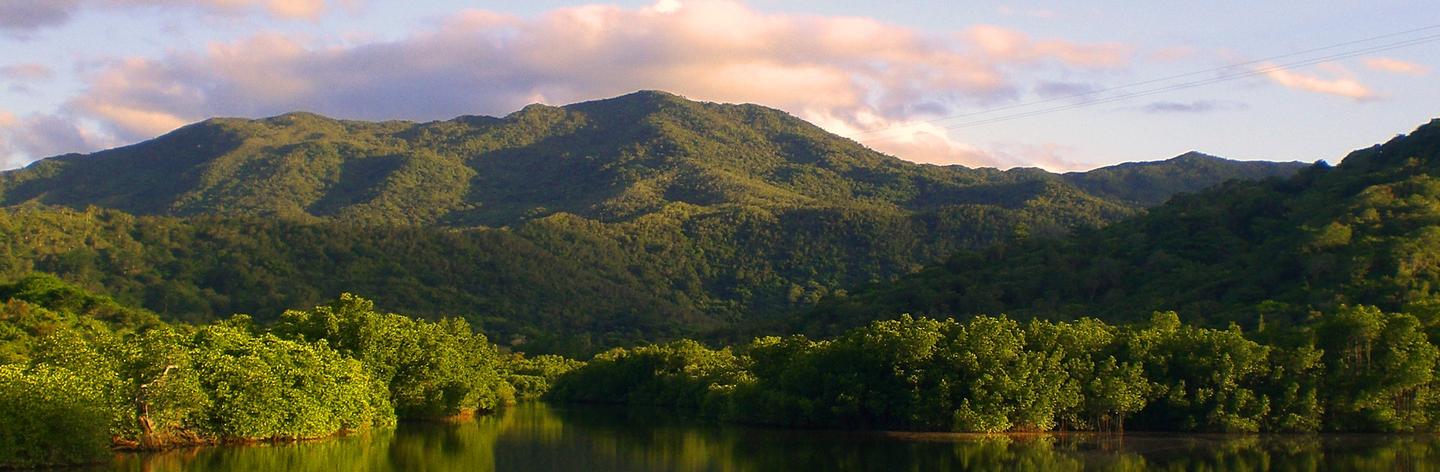
The Foja Mountains only grudgingly gave up its secrets on this second expedition. Rivers were in flood much of the time, the bog at the famous Bog Camp was flooded virtually the entire field season, and rain pelted the fieldworkers day and night.
This made for uncertain airplane and helicopter charters, and in two instances, the chartered helicopter was forced to abandon its work because of inclement weather, leaving scientists without their needed transportation to get where they wanted to go.
But this sort of thing is expected in a place like the Foja Mountains, and the scientists are rough-and-ready, so they simply adapted to the conditions, and worked in the rain, and, with time, uncovered lots of interesting and novel plants and animals.
Dr. Wayne Takeuchi reported that his camp in the foothills at 850 meters elevation was perhaps the richest and most unusual forest he has visited in New Guinea. It produced an abundance of unusual and new plants. Trouble was, because of bad weather and a shortage of rice, the survey team had to retreat into the lowland and back to Kwerba village before Wayne’s work was completed.
The mountain team was able to brush off the rain and ascend to the summit of the Fojas – a place never before visited by Western scientists. The mountaintop was quite unlike anything they expected. It was flat-topped and cloaked in a grand mossy montane forest quite unlike what they knew from the Bog Camp. But search for the rumored black tree kangaroo was unsuccessful. At the same time, a camera trap set on a fallen log produced close-up photos of the golden-mantled tree-kangaroo – never before photographed in the wild.
The researchers encountered various marvelous species. It will be months before the team completes initial taxonomic identification of all the species that we encountered.
But the sense of the team is that our third and final visit to the Foja Mountains has wrapped up this stage of field investigation. The results of the work in 2005, 2007 and 2008 will be compiled into a major RAP report and published in 2009.
– Reported by Bruce Beehler
Photos (right): Foja Mountains upland forest (top) and Foja Mountains upland bog (bottom). © Bruce Beehler/CI
LEARN MORE:
Return to main 2008 Foja Expedition Overview.
See all Foja Expeditions.
More dispatches from the field.